
Analyst Call on Baidu Shows Why Most Wall Street Research Calls Are Useless

There are several reasons I typically ignore Wall Street analyst calls. The most compelling is the fact that sell side recommendations over the long term have been shown to underperform the market with above average volatility. Those are lose-lose metrics for investors.

Such poor performance is largely attributable to analysts being backward looking when they make research calls, despite the fact that they are supposed to be analyzing the equity market, which is a forward looking mechanism. Too many times analysts will upgrade stocks after the firms report strong numbers and vice versa, which does nothing to add to investor returns relative to the benchmark index they are trying to beat. Successful investing requires insight into the future, not reaction to the past.

To illustrate this point, consider an upgrade from UBS analyst Wenlin Li on Monday. Li covers Baidu.com (BIDU), the internet search giant in China. Baidu reported second quarter earnings of $1.61 per share, above consensus estimates of $1.44.

Prior to the earnings report Li had a sell rating and $150 price target on Baidu, which was trading over $300 per share. That in itself appears to be a contrarian call, which would be commendable (wrong, but commendable nonetheless). After the strong report was released, despite only a small upside surprise, Li upgraded the stock to neutral and raised the price target to $380 per share, a stunning increase of 153 percent.

How does a single quarter's earnings beat of 12 percent explain a 153 percent increase in one's fair value estimate for a stock? It doesn't, not by a long shot. This is the epitome of a completely useless Wall Street research call.

To see how this analyst messed up so badly, we only need to look at the changes made to their BIDU assumptions. Li now estimates 2009 revenue at $658 million, up from $542 million, while 2010 and 2011 sales are revised upward by 33% and 38%, respectively. Gross profit as a percentage of sales estimates were also revised upward, by 60% this year, next year and 2011, and net profit was revised up by about 40% per year.

Remember, an analyst's sole job is to follow companies and estimate how much revenue they will bring in and what proportion of that will flow through to the bottom line. Without solid insight into these metrics ahead of time, analyst calls are of little use to investors, which unfortunately is the case more often than not on Wall Street.

Full Disclosure: No position in BIDU at the time of writing, but positions may change at any time
Chrysler, Ford Riding Government Incentives to First Sales Gains in 2 Years

It is hard to argue with the success of the "Cash for Clunkers" automobile incentive program so far. With $1 billion already blown through, Congress is working on a $2 billion extension, despite most Republicans being against the program (probably because it was a Democratic idea, not because it is not working).

So far the average consumer is trading in their clunker for a new car that gets 9 miles per gallon more than the vehicle it replaced. The sales spike during the last week of July has led both Chrysler and Ford to report July sales gains, the first increase in 2 years for the domestic automobile industry. General Motors reported a 19% decline in sales, but still saw an enormous benefit from the program.

It remains to be seen if car sales will be sustained at higher levels, but the glass looks half full at this point. New car inventories are near all-time lows so inventory rebuilding in coming months should boost GDP pretty significantly, perhaps leading to a positive GDP print for the third quarter.

The car companies are not the only beneficiaries, however. "Cash for Clunkers" helps consumers and the country as a whole too. Higher fuel efficiency should not be understated. Consumers will save money by spending less to fill up their gas tanks, freeing up money for other things. In addition, less pollution from the new vehicles not only is safer for Americans but the environment in general as well.

Despite skepticism from many, this program does this show that smart government spending can stimulate the economy. In this case it does so in more ways than one, making the investment well worth the several billion dollars spent.

Full Disclosure: No positions in Ford or GM at the time of writing, but positions may change at any time

Yahoo! Accepts No Cash Upfront As Microsoft Search Deal Is Finally Reached

Eighteen months ago Yahoo (YHOO) management rejected a $33 per share, $47.5 billion cash takeover offer from Microsoft (MSFT). Today the two companies have announced a search partnership that makes Microsoft's Bing the default search engine on Yahoo and gives Yahoo no cash upfront for the privilege. This story is likely one of the worst executive management screw-ups in U.S. corporate history.

Yahoo shares had traded up to $17 each on anticipation of a deal with Microsoft but are trading down sharply today after the actual terms were announced. Yahoo will receive 88% of search revenue, while Microsoft will keep 12% for providing its technology. Yahoo saves money by not having to run its own search technology.

Who wins with this deal? Both companies, but Microsoft more so. Bing instantly increases its global market share from 6% to 15% by being incorporated into Yahoo's sites. That still pales in comparison to Google's 81% global share, but there is not much more room left to conquer now. Microsoft still makes some money here, even only keeping 12% of revenue, because market share has risen by 150% overnight.

Yahoo estimates that its annual operating cash flow will rise by $275 million from this deal, but it will take two years to be fully implemented. At their current valuation, that means about $3 per share of value creation, a far cry from the $14 of value creation ($33 cash versus $19 stock price at the time) that was offered by Microsoft and subsequently rejected as "undervaluing the company."

And remember, these numbers are Yahoo estimates so they are going to be overly optimistic. A lot can change in 24 months, which is how long they think it will take to revamp these operations and integrate both companies into this new search structure.

Does this deal hurt Google (GOOG)? Not really, in my view. Do they care who has the 19% global search market share that does not flow through Google sites? Probably not, unless they really think Bing is so good that it will lure search queries away from them.

Given Microsoft's history on the web, and with search products more specifically, it is hard to fear Bing, even if it has Yahoo as a partner now. Aside from Xbox, Microsoft has had little success diversifying away from Windows based operating systems and office software products. Putting two mediocre online players together is unlikely to have a dramatic effect on the industry landscape, although it will save each some resources.

As for the stocks, Peridot Capital has small positions in all three. Microsoft appears the most attractive at current prices, as Google is approaching fair value. Yahoo is less appealing now that an outright takeover by Microsoft is less likely. They could possibly come after the rest of Yahoo at some point in the future, but owning the stock for that reason solely is not very intriguing.

Full Disclosure: Peridot Capital was long shares of GOOG, MSFT, and YHOO at the time of writing, but positions may change at any time.

Do Not Be Fooled, Earnings (Not Sales) Are What Truly Matter

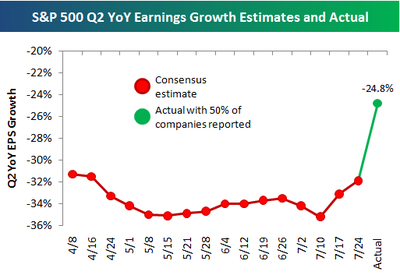
The U.S. stock market has rallied six percent so far this week after second quarter earnings have thus far boosted investor confidence. The four large companies getting the most attention this week have all surpassed estimates (Goldman Sachs, Intel, Johnson and Johnson, and Yum Brands).

It is hard to paint these results with anything but a positive brush, but that has not stopped many commentators from trying to throw cold water on the initial set of earnings reports. Their core argument (which we hear all the time from the bears and really frustrates me) is that while earnings have been solid, sales have been uninspiring. "You can't cut your way to prosperity" they say, alluding to the fact that cost cuts are helping U.S. companies exceed consensus profit expectations.

I roll my eyes when I hear this logic because sales are pretty much irrelevant when valuing equities. Shareholders own a proportional claim on a company's future profits, not sales. Heck, if sales were all that mattered, the dot com bubble never would have burst and shareholders of pets.com would still be rich. The Internet bubble popped because selling dollar bills for ninety cents is not a sustainable business model. You might be able to rack up some serious sales growth that way, but the business will not survive.

Now, I do not disagree with the notion that sales have been lackluster. After all, we are in a recession so anything but weak sales would be a real surprise. Just remember that stock prices are based on earnings, not sales. As a result, if the companies I own can boost profits by cost cutting while the economy is in decline, that is fine by me. Once the recession ends, we will have plenty of time for sales growth to impress everyone.

Meredith Whitney's "Buy Goldman Sachs" Call Lifts Market, But Comes A Little Late

My frequency of posting has diminished here lately, mainly due to the fact that not much interesting seems to be happening (at least from my perspective). I always err on the side of posting less rather than writing just for the sake of doing so without having much to say.

Stocks are rising smartly today after renown banking bear Meredith Whitney (now at her own firm) actually had positive things to say about investment banking giant Goldman Sachs (GS), upgrading the stock to a "buy" and raising her price target to $186 per share. GS shares are trading up 7 points to $149 each.

While the market is making a big deal about this call today, we have to remember that everyone knows Goldman Sachs is firing on all cylinders lately, so this should come as no surprise. Getting in the stock ahead of earnings (especially on an up seven point day) may backfire for some people tomorrow (GS reports earnings tomorrow morning) who are getting excited about Whitney's bullish note.

Frankly, the best time to get into Goldman was when the stock was down a lot (you know, when Warren Buffett bought a 10% preferred from the company and got equity warrants). As you can see from the chart below, GS shares had a huge move down, and even before today had made a ton of it back already.

gs1year.gif

While Whitney's call looks late to me, she has taken earnings estimates well above consensus, which makes the stock by no means expensive even at $149 per share. Whitney's 2010 profit estimate is nearly $20 per share, so there is no reason the stock couldn't trade higher from here if she is right. Still, I would have loved this call had it come when the stock traded below $50 near its low, or even after a double to $100. Now it has already tripled.

In terms of the large commercial banks, Whitney appears to be hedging her bets (probably because deep down she knows that the worst is behind us for the banking sector). She is bullish near term (thanks to a booming mortgage business), but bearish long term. This seems like a hedge because, if anything, logic would dictate one being bearish on banks in the short term (while the economy is still in the dumps), and bullish longer term (because the recession is certain to end).

Part of her long term bearish view is the fact that she thinks the unemployment rate is going to reach 13-14 percent. It seems odds for a banking analyst to be making predictions like that. Not that economists are any good at forecasting the jobless rate (they're not at all), but to think the unemployment rate will rise another 4% from the current 9.5% seems overly negative to me, especially given the source. After all, many people are expecting positive GDP as soon as the third quarter of this year.

All in all, I think the market is placing too much importance on Whitney's comments this morning. Not much has changed, really. We already knew Goldman was printing money, mortgage refinances were doing well, and that the economy was still rather poor. It seems like Whitney is making both bullish and bearish comments at the same time to cover her bases.

As a result, I don't think there is much to go on from her views at this point. Unless you think the economy will never recover (and the unemployment rate will hit 13 or 14 percent), I would just buy your favorite bank stocks at attractive prices and hold them for a few years. There is still plenty of money to be made in the sector if you have patience.

Full Disclosure: No position in GS at the time of writing, but positions may change at any time

After 350% Gain, AutoNation Shares Look Pricey

Typically when I write about individual stocks on this blog I share bullish ideas that I am either long or thinking about going long. I was recently doing some work on AutoNation (AN), however, and since the stock looks pricey to me I figured I would share a bearish case as well.

The reason for a contrarian like me to look under the hood of AutoNation is pretty straightforward. The U.S. automobile industry is obviously struggling right now but AN has strong management and the dealers are in better shape than the car markers themselves (cost structures are more in-line without union obligations, etc). Couple that with strong buy side interest from Eddie Lampert's ESL Investments and Bill Gates affiliated Cascade Investments and my interest was peaked.

That said, it appears that I missed the boat on AutoNation, at least for now. The stock has soared 350% from under $4 per share to near $18, just below a 52-week high. The stock's P/E of around 20x is high, but part of that is due to cyclically poor earnings during the current recession.

I looked back at AutoNation's financial statements for 2006-2007 and found that earnings per share peaked at around $1.45 during the boom years. Even at that level of profitability, AN stock trades at 12 times earnings, hardly a bargain for a slow growing automobile retailer.

AutoNation has a strong share buyback program in place, which is attractive to me, and the auto retail business should slowly improve in coming years, so AN is on my radar screen. However, given the current price and the move the stock has already made (ESL and Cascade timed their buys very well), I am not a buyer here. If we got down to the low teens, perhaps I would take another look.

Full Disclosure: No position in AutoNation at the time of writing, but positions may change at any time

Investors' Thirst for U.S. Government Debt Yet To Be Quenched

We have been hearing warnings for years. Just wait until China stops buying our debt... the borrow and spend cycle in the U.S. will come to a grinding halt. Since the Obama Administration has already spent about $1.4 trillion (~$800 billion on stimulus and ~$600 billion on a down payment for healthcare reform), these calls are growing ever more prevalent.

Of course, China will continue to have excess cash reserves that need to be invested, and they only own a fraction -- less than 10 percent -- of the total U.S. debt outstanding (contrary to the widespread belief that they effectively own the United States), but it is not unreasonable to think demand would drop a bit as we continue to borrow money. The interesting thing, however, is that demand for U.S. debt is showing no signs of slowing down.

Part of the reason the stock market is doing so well today (Dow up 150 with less than one hour of trading left to go) is because we got the results of yet another U.S. debt auction and it went very well. The U.S. successfully sold $27 billion of seven-year notes with strong demand.

Demand can easily be gauged by what is called the "bid to cover ratio" which simply tells you how many dollars of bids were submitted for each dollar of debt that was auctioned off. Today's note offering registered a bid to cover of 2.82 so we received $76 billion of bids for only $27 billion of notes.

Are we paying through the nose for this money? Not exactly. The yield on the 10-year bond right now is around 3.5% or so. I wish I could borrow money for 10 years at 3.5%. Not only is the government trying to do so, but it is finding great success even in this fiscal environment. To me, that bodes well for the future of the United States.

CNBC's David Faber Publishes Book Follow-Up To "House of Cards" Documentary

Several months ago I pointed out that CNBC's David Faber put together a two hour documentary about the housing bust and credit crisis entitled "The House of Cards." I got lots of positive feedback from readers who watched the special so I thought I would let everyone know that Faber has written a book (just released) on the topic, which branches out from his television special.

The book is called"And Then the Roof Caved In: How Wall Street Greed and Stupidity Brought Capitalism to Its Knees" and it appears the early reviews are superb. On Amazon.com, for instance, the first 21 ratings from customers have all given the book 5 out of 5 stars. If the last few years of U.S. economics and finance interest you, I strongly recommend it if you are looking for some quality reading material.

U.S. Energy Department Paves Way for Nuclear Power Plants, Public Companies To Benefit

You may have heard that the U.S. Department of Energy is planning to offer $18.5 billion in loan guarantees for the construction of more nuclear power plants. Not only would additional nuclear capacity reduce greenhouse gas emissions, it would also help private energy companies boost their market positions. Federal loan guarantees will reduce the cost of capital and make expanded nuclear power an easier goal to attain.

This is good news for investors too, as four publicly traded companies will share the $18.5 billion raised. The companies include NRG Energy (NRG), Scana (SCG), The Southern Company (SO), and UniStar, a joint venture between France's EDF and Constellation Energy (CEG). These utility stocks are already fairly inexpensive on a valuation basis, with high dividend yields, so new future growth opportunities will only make them even more attractive.

The growth will help some more than others (Southern, for example, is a huge power player already, so nuclear might not make a large dent in their business), but I believe ventures like these serve to identify the leaders in the energy transformation movement. As a result, investors may want to take a closer look.

Full Disclosure: Peridot Capital was long shares of Constellation Energy preferred stock at the time of writing, but positions may change at any time