
Contrary To Media Reports, Rising Housing Starts Are Not A Good Sign

From the Associated Press this morning:

"Construction of new homes jumped in May by the largest amount in three months, an encouraging sign that the nation's deep housing recession was beginning to bottom out. The Commerce Department said Tuesday that construction of new homes and apartments jumped 17.2 percent last month to a seasonally adjusted annual rate of 532,000 units. That was better than the 500,000-unit pace that economists had expected and came after construction fell in April to a record low of 454,000 units. In another encouraging sign, applications for building permits, seen as a good indicator of future activity, rose 4 percent in May to an annual rate of 518,000 units. The better-than-expected rebound in construction was the latest sign that the prolonged slump in housing is coming to an end, which would be good news for the broader economy."

Pretty lousy analysis if you ask me. It is true that more construction will show up in GDP calculations as so-called "economic growth" but the idea that growth in housing starts is good for the housing market and means the housing recession is coming to an end is completely wrong.

In case the AP hasn't noticed, housing prices are cratering due to a supply-demand imbalance. When supply exceeds demand, prices drop (economics 101). It is widely believed (and I agree) that a bottom in housing prices (and therefore an end to the housing recession) is needed before the U.S. economy can really begin a sustainable recovery (such an event would boost consumer confidence and spending, and help the banks feel better about extending credit). In order for home prices to stabilize, we need the supply-demand picture to balance out.

How will supply and demand meet if we build more supply when the problem has been (and continues to be) an excess supply of unsold homes? They won't, which is why a pick up in housing starts will only serve to prolong the housing recession, not help to curb it. Hopefully the pick up in May is a one month phenomenon.
Profit On TARP Repayments Only To Cancel Out Other Losses

Before we start jumping for joy that the government stands to make a nice profit on the $68 billion of TARP money that is now eligible to be repaid, let's consider that the gains are only from relatively healthy institutions. By forcing each of the nation's biggest banks to accept TARP funds, former Treasury Secretary Paulson essentially assured profits would be generated on some of the loans, but we really need to look at the big picture. In order for the taxpayer to come out ahead, the gains on the good investments need to cancel out the losses on the bad ones.

Do the profits on $68 billion of TARP capital do the trick? Hardly. AIG received $70 billion from TARP, GM and Chrysler got $17.4 billion, and another $30 billion in slated to fund bankruptcy proceedings for the auto makers. That's more than $117 billion that the government has tied up in 3 firms. It will take years to get that money back, and in the case of AIG, it appears unlikely a full recovery is a reasonable expectation. So, while $68 billion coming back to us is a good thing, let's not get carried away and start calling TARP a solid "investment" just yet.

Full Disclosure: No position in AIG or GM at the time of writing, but positions may change at any time (unlikely in this case, however)

Interest Rates Only High If Compared With Six Months Ago

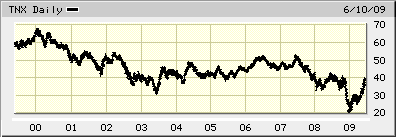
Call me a skeptic when it comes to getting really nervous about rising interest rates. "All of this debt we are selling is really having a severe impact on interest rates," they say. It is true that interest rates on 10-year government bonds have doubled from 2% to 4% in recent months. However, not looking more than six or twelve months back does not give a very clear picture. Below is a decade-long chart of the yield on the benchmark 10-year treasury bond:

tnxchart.gif

See why I am not buying the whole "higher interest rates will kill the economic recovery" argument? Yields between 4% and 6% were pretty common before the recession began and they existed with solid economic growth and less government debt. Even if yields rise further, to the 5%-6% range, it won't be the end of the world. In fact, it might actually be nice for consumers. We finally have a positive savings rate in the U.S. and it would be good to get bank certificates of deposit to yield 5% again so those dollars being saved could earn solid interest.

Of course, many will argue that if mortgage rates reach 6%-7% the housing market will never recover because people will no longer be able to afford to buy a house. Consider these numbers, though. The monthly payment on a $200,000 mortgage at 5.5% (today's rate) is $1,136, compared with $1,331 at a 7% mortgage rate. If you are earning ~$5,000 per month (about what you should make to buy a $200,000 house) another $200 per month (before the interest tax deduction, mind you) really should not be the difference between renting and buying for most people. Mortgage rates would have to go up a lot more to cripple the housing market, in my view.

Powerful Market Rally May Be Running Out of Steam

After a very surprising employment report this morning (payrolls declined ~350k versus expectations of ~525k), the market reacted well at first but sellers have emerged. The fact that the market is flat today tells me the rally is losing steam (normally that type of jobs report would mean 200 or 300 points on the Dow). We may be at a point now where slow economic improvement has been priced into stocks, and as a result, incoming data that supports that thesis may not give a huge jolt to equity prices going forward.

This is a perfect example of how the stock market discounts the future ahead of time. We have had an enormous move since early March (S&P 500 up 42% from 666 to 944) on expectations that the economy would begin to slowly improve. Now that it appears to be happening, the market is looking ahead at what might be next. The answer to that question is a lot less clear.

My personal fair value target for the S&P 500 remains 1,050 but I have been raising cash into this rally below that level because there are still risks to the economic recovery and I want to save some cash for the next market drop. Recovery has to be a foregone conclusion, in my view, for the 1,050 level to solely dictate my actions.

Not only that, but more and more strategists are looking for 1,000 on the S&P 500, whereas they weren't even mentioning it as a possibility a month or two ago. As a contrarian, that makes me think it is getting less likely we will reach that level in the short term.

Market Loves GM Bankruptcy

I kid, of course. The market is up 200 points today, not because GM is filing bankruptcy, but rather because investors seem to understand that the event itself is not at all catastrophic. After all, Chrysler is emerging from bankruptcy shortly and actually saw sales go up after they filed. It seems that most people, investors and car buyers alike, understand that Chapter 11 is a legal corporate process first and foremost and should be an afterthought to car buyers. Still, who would have thought the market would react quite so well initially?

Two short points on GM. First, the stock is up 20% today to about 90 cents. It's worthless, folks. Those who still grip their "efficient markets hypothesis" tightly can use this as a perfect case study against the theory.

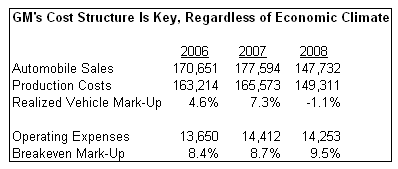
Second, how will we be able to judge whether "New GM" is viable long term after they emerge from bankruptcy (which many say will be before summer ends)? It's all about cost structure. Many attribute their latest woes chiefly to the weak economy and lack of credit, but they seem to have forgotten that GM was a money loser in 2006 and 2007, when credit was flowing more freely than any other time in our history.

Consider the chart below, which shows how far from profits GM has been over the last three years:

gmcosts.png

As you can see, GM needed a near-10% mark-up over cost to breakeven on their vehicles. They never hit that goal in 2006-2007, even before they started selling cars for less than they built them for in 2008. If "New GM" can get their costs down, and have them be predictable and stay low, the company might be able to make a comeback down the road. It won't be easy, but Chapter 11 was the only way to make it even a reasonable possibility.

Full Disclosure: No position in GM, past or present.

Why Selling Your GM Stock Makes Sense, Even If Bankruptcy Is Averted

General Motors (GM) is working with bond holders to try and avert a bankruptcy filing. There are reports this morning that an agreement on a proposed debt for equity swap may have been reached. For current GM shareholders the question is pretty simple, should you sell at the current price of $1.35 per share?

Well, if GM files chapter 11 shareholders will very likely be wiped out completely (there have been a few cases when they aren't, but it's very unlikely). But what if the bond holders agree to certain terms and the company avoids bankruptcy? Isn't that possibility the sole reason GM shares trade at more than $1 right now, even though the company is effectively bankrupt?

The short answer is yes, but consider another fact. In the latest proposal made to bond holders, current GM equity holders would retain 1% of the newly restructured company's stock. In order to make the case to hold onto GM stock today, one has to argue that General Motors equity, after the restructuring, will be worth at least $80 billion (100 times the current $800 million market capitalization). How would one even begin to make that case?

Update: Smart Phone Makers Ripe for Profit Taking

Earlier this year I wrote separate pieces highlighting both Research in Motion (RIMM), maker of the Blackberry and smart phone staple, and Palm (PALM), the turnaround story trying to get their name back into the mix. In the four months or so since then both stocks have soared, nearly doubling in each case (PALM from $6 to $11 and RIMM from $44 to $78). Not surprisingly, these are instances when taking profits makes sense.

The competitive landscape for Research in Motion really hasn't changed since February. The stock move is based on two things; the overall market advance, as well as renewed optimism that Blackberries remain popular devices and profit margins will hold up nicely even in this heightened period of competition and economic challenges. RIMM has seen its P/E ratio on 2009 earnings estimates jump from a very meager 13 times to a more reasonable 20 times, which seems more appropriate to me.

In Palm's case, the stock has moved in anticipation of their new device, the Pre, set to debut June 6th. While the prospects remain bright for both the Pre and subsequent devices Palm is sure to launch in coming quarters, we often see a sell off in the stocks of tech companies heading into or right after major product releases (so called "buy the rumor, sell the news"). In order for Palm shares to make new highs above the recent peak of $14 $12 per share, the Pre launch really must go perfectly. However, as is the case with many new product launches, expectations are high and there can be hiccups along the way. Therefore, there will be opportunities for investors with big gains to take profits and put selling pressure on the stock.

In both of these cases, investors who have sizable gains and still believe in either or both of these companies longer term can have their cake and eat it too by taking some chips off the table and keeping a smaller position to profit from if their instincts are right about the future.

Full Disclosure: Peridot Capital was long shares of Palm at the time of writing, although the position has become smaller in recent weeks, and positions may change at any time

Do Americans Want To Buy Fuel Efficient Cars?

There appears to be debate on this question, which is puzzling to me. I think many people are mistakenly under the assumption that "small, fuel efficient" cars equate to miniature so called "smart" cars that we see every so often on the road and in Europe, as opposed to simply something other than a gas guzzling SUV or crossover vehicle. In fact, most sedans today are very fuel efficient.

Will U.S. consumers buy these cars? Well, that question has actually already been answered. As you can see from the chart below, the top 5 best selling cars in the U.S. get more than 30 miles per gallon on the highway, and #6 on the list isn't too far behind:

2008bestsellingcars.png

"Buy and Hold" Doesn't Work If You Completely Ignore Valuation

The current bear market resulted in the first negative ten-year period for the U.S. stock market in a long time. This has prompted many people to declare that the investment strategy of buying and holding stocks for the long term ("buy and "hold" for short) is all of the sudden "dead" or no longer viable.

Personally, I find this death pronouncement a bit odd. Just because stocks went nowhere from 1999-2008 means that investing in stocks for ten years is flawed generally? Since when does one instance of something not working render the entire concept flawed? I don't think a 100 percent success rate is required for one to declare it a viable strategy.

The reason "buy and hold" became popular is because, over long periods of time, stock prices mimic corporate earnings, which have risen over business cycles since the beginning of our economy. Legendary fund manager Peter Lynch continually reminds people that it is no coincidence that over decades the gains in the U.S. stock market are practically identical to the gains in corporate earnings (stock ownership represents a proportional share in profits generated by the firm).

The key point here is that the relationship only holds over long periods of time. In any given year, there is virtually no correlation between earnings growth rates and equity market gains. That is why "buy and hold" is a widely accepted investment strategy. If you invest over the long term, the odds are extremely high that earnings and stock prices will rise, and do so at higher rates than other investment alternatives.

I bring this up today because a former CEO of Coca Cola was a guest host on CNBC this morning. He and the CNBC gang discussed the fact that shares of Coke are actually down over the last ten years (since this person left the CEO post), as the chart below shows.

kochart.gif

The CNBC commentators were quick to point out that Coke's earnings have more than doubled over the past decade, but the stock has actually lost value. Does this example support the idea that "buy and hold" is a flawed strategy, or is there something else at work here?

The latter. Coke stock carried a P/E ratio above 50 back in the late 1990's, during the blue chip bull market. Even when earnings grow dramatically, if P/E ratios are in nose bleed territory, "buy and hold" may not work, as was the case with Coke.

As a result, "buy and hold" does not work blindly. If you dramatically overpay for a stock, there is a good chance that you won't make any money, even over an entire decade. From my perspective, this does not mean that "buy and hold" is dead (the long term relationship between earnings and stock prices is unchanged), it simply means that valuation is important in determining future stock price returns (statistics show it is the most important, in fact).

The takeaway from this discussion is that "buy and hold" investors are likely to do very well over the long term, as long as they don't grossly overpay for an asset. The U.S. stock market in the late 1990's was more expensive, on a valuation basis, than at any other time in its history. Buyers during that time can't be saved from their own poor decision of paying too much for a stock, even by a proven long term investment strategy. Unfortunately, most non-professional individual investors don't focus on valuation when picking stocks for their portfolios, and often pay the price as a result.

Full Disclosure: No position in Coca Cola at the time of writing, but positions may change at any time