
The Idea That Banks Aren't Lending Anymore Is Ridiculous

One of the worst parts of being a money manager is that in order to stay on top of financial news one should really have CNBC on in the office constantly. There are many people on CNBC that I thoroughly enjoy (David Faber and Erin Burnett, to name a couple), but I say this because you also have to hear a bunch of garbage that people continually spew out of their mouths.

One of the things you constantly here nowadays is that "banks aren't lending anymore." Whether it is a politician who is upset about how the government's money is being spent, or an economic doomsayer, this statement is simply untrue based on actual reported data (sorry, I'm a stickler for actual data). Depending on how strong a bank is right now, lending for the most part has either been increasing modestly, staying flat, or dropping modestly. Claiming that banks aren't lending anymore implies that loan volumes have simply fallen off a cliff, but nobody making these accusations ever can back it up with any facts when pressed.

Take the fourth quarter earnings report from JPMorgan Chase (JPM) released today. Despite an economy that shrunk during the quarter, JPM's total consumer loans rose by 2% or $10 billion, to $483 billion, between September 30th and December 31st. This is not an aberration. As we will see (and I will add more data to this post as it comes in) most banks will show similar numbers for the latest quarter.

Given that economic growth is negative and unemployment is rising, one could easily understand if lending dropped during a recession. After all, if the core problem was lax lending standards and those standards are being revised upward, lending should be going down, not up. Evidence of increases or simply a stagnation in loan levels goes against exactly what many are claiming (that the banks are hoarding capital).

It is certainly true that someone with a FICO score of 500 or 600 (sub-prime) might not get a loan in today's environment, but that does not mean that banks aren't lending. Instead, it means that banks are not giving money to people who likely won't be able to pay it back. Isn't that exactly what we want, given that the sub-prime mortgage crisis is what got us here in the first place?

Remember, numbers don't lie but people do. For some reason too many people seem to want to blame the banks for more than their fair share, and that is saying a lot given that these institutions don't exactly have impressive operating track records recently.

Full Disclosure: No position in JPM at the time of writing, but positions may change at any time

Update (1/16/09):

Consumer Loans Q4 2008 vs Q3 2008

Bank of America -2%, Citigroup -4% vs JPMorgan +2%

Makes sense given the relative strengths of each bank. In all three cases, loan growth is rising faster than GDP. Banks are lending, you just need to be a prime borrower to qualify (and the majority of U.S. consumers are in prime territory).
Despite Capital Infusions, U.S. Government Should Not Dictate Bank Behavior

With at least a mini Citigroup (C) break-up plan coming to fruition, there is chatter that the U.S. government has a hand in some of these decisions. The justification is that the TARP program has resulted in the government directly injecting capital into banks like Citigroup, and as a result they are shareholders and have a large influence on guiding future operational decisions.

This is an interesting assumption because the government does not own common shares in Citigroup or any other U.S. bank, and therefore has no controlling rights like other shareholders do. The preferred shares the government bought carry no voting rights, as that is a core characteristic of preferred stock. The government does have warrants to buy common stock in the future, but those warrants are under water and as long as they are not exercised, they don't bring with them any rights of control.

If the government really is behind much of Citigroup's decision making, it may signal that the bank knows it will need more financial assistance down the road and therefore feels it must comply with government requests. If not, I would tell them to buzz off.

As for the break-up plan itself, does it make me bullish on Citigroup stock? Not really. While it is a step in the right direction, Citi still has one of the weakest balance sheets in the industry. It is practically impossible to know what their assets are worth and how high future losses will be. As a result, trying to accurately value the company is extremely difficult. The stock is cheap, but that alone is not enough of a reason to buy it.

Full Disclosure: No position in Citigroup at the time of writing, but positions may change at any time

Brokerage Joint Venture With Morgan Stanley Is Positive Step For Citigroup

I have written previously, as have numerous other investment managers, that in order for Citigroup (C) to have the best chance of being nimble enough to grow and be managed efficiently it needed to be broken up. The vast number of businesses they have, coupled with the dozens of countries they conduct business in, would make it extremely difficult for anyone, including current CEO Vikram Pandit, to successfully manage the company.

It now appears we are a day or two away from hearing from Citigroup that they are contributing their Smith Barney retail brokerage division to form a joint venture with Morgan Stanley's retail business. The combination would have more than 21,000 brokers, making it the largest brokerage firm in the world.

Although a dramatic shift from prior assurances from Citigroup CEO Vikram Pandit that he would not break up the company, I think this joint venture makes a lot of sense from their perspective. Under the rumored terms of the deal, Morgan Stanley would own 51% and manage the joint venture. Citigroup would own 49% and receive a ~$2.5 billion equalization fee (to account for the fact that Smith Barney has more brokers than Morgan Stanley).

Initial press reports had Citigroup selling 51% for $2.5 billion, which made little sense since it would only value the unit at about $5 billion. However, it appears they are getting $2.5 billion in cash and a 49% stake, which sounds more like it. In addition to the cash, Pandit downsizes Citigroup and makes his job of managing it a whole lot easier.

While this deal does not put an exact dollar value on Smith Barney (the joint venture will not trade publicly), which would have helped Citigroup shareholders more easily justify the current $6 stock price, it does give Morgan Stanley the option to buy out Citi's 49% stake in the future. While I would not suggest Citigroup sell the entire thing (it is doing far better than their banking businesses), this deal does manage to raise capital and make the large bank more manageable.

While not a life saver, this deal does make some sense, which is more than we can say about Citigroup's business decisions in recent memory.

Full Disclosure: No position in Citigroup or Morgan Stanley at the time of writing, but positions may change at any time

Fourth Quarter Earnings Will Be Horrible, But We Already Know That

Aluminum giant Alcoa (AA) kicks off fourth quarter earnings season after the closing bell today and there is little doubt that they will be the first in a series of profit reports over the next few weeks that will be absolutely brutal. Fortunately, most investors already know that, so the market's reaction is unlikely to mirror the dramatic sell-off we saw in October and November. The fourth quarter could prove to be the weakest quarter of the entire recession in terms of GDP growth (a 5 or 6 percent decline is both possible and probable), which would imply that corporate profits have no chance of exceeding expectations this quarter.

The key, however, is not what the numbers are but rather how the market reacts to them. With sentiment so negative on the earnings front, there will be instances where stocks actually do not drop, or even rise slightly after poor profit reports are announced. Since the stock market is forward looking, a company reporting a lousy number, if no worse than expected, will actually bring smiles to investors' eyes because it alleviates the concern that things could be even worse than many believe they are.

How the market reacts during this earnings season will be very telling for the near-term dynamics of Wall Street. If numbers come in weak as expected, but not a lot worse than the already low expectations, technical analysts will be quick to point that out as a positive sign. This would be a key signal that the market has reached a short term bottom. Such action would tell me that the market is truly looking ahead to possible economic stimulus and other actions that could help make the fourth quarter the worst quarterly GDP reading we ultimately see.

Conversely, a poor market reaction to these profit reports could mean a retest of the November lows. The market has done pretty well in recent weeks as it looks ahead to an Obama administration, but its patience will certainly be tested over the next couple of weeks. Personally, I think we will see a modestly negative reaction over the short-term, only because we have already seen a decent level of bargain hunting prior to earnings season.

Full Disclosure: No position in Alcoa at the time of writing, but positions may change at any time

Action in Palm Stock Highlights Why Analyst Recommendations Continually Fail Investors

In recent months it would have been difficult to find a stock that Wall Street analysts were more pessimistic about than struggling smart-phone maker Palm (PALM). According to Thomson/First Call, 23 analysts follow the stock, 10 have sell ratings, and only 2 have buy ratings (the rest were neutral). In a world where brokerage firms make money by getting people to buy stocks, such negative sentiment is rare.

As a contrarian, I had actually been accumulating shares of Palm throughout 2008 in some client accounts, as hints of a possible recovery in the company's business began to appear. Most notably, the combination of a sizable equity investment from private equity firm Elevation Partners (run by Roger McNamee, a man I have great respect for) and the hiring a former research and development star from Apple (Jon Rubenstein).

In recent months Palm had explained to investors that they were revamping their software platform and with the help of Rubenstein and McNamee were set to launch a new set of innovative products in 2009. Given how short-sighted Wall Street is, Palm shares struggled as the iPhone and new Blackberry products came to market. Wall Street analysts were negative on Palm because they claimed Apple and Research in Motion were way ahead of them in terms of products and market share. The stock actually reached a low of $1.14 per share in December, down from $4.00 just a month earlier.

The reason I was interested in the stock was not because I disagreed with the analysts' assumptions (I too expect Apple and RIM to have higher market share than Palm), but rather because they were ignoring the fact that the global cell phone market is over 1.2 billion units. Palm could lag Apple and RIM and still collect 5% or 10% of the worldwide market, which would translate into tens of millions of units and perhaps several billion dollars of revenue. The idea that Palm had to beat out Apple and RIM to stay in business (some analysts are projecting Palm will file bankruptcy) seemed off the mark to me.

Sell side analysts generally recommend stocks based on what is known, not what could happen in the future. Even though the public knew a successful R&D guy from Apple was now heading up Palm and was slated to introduce a brand new operating system and product lineup in 2009, since the facts at the time were that Apple and RIM were crushing Palm, practically nobody on the Street liked the stock. At a buck or two though, Wall Street was pricing Palm shares based on the worst case scenario, so the risk-reward trade-off highly favored going long the stock, not betting against it.

Last month Elevation Partners increased their equity investment in Palm from $325 million to $425 million, obviously approving of the company's plan. Yesterday at the Consumer Electronics Show (CES) in Las Vegas Palm unveiled its new operating system and a model of the Palm Pre, the first of its next generation smart-phone products schedule to be released by Sprint in the U.S. sometime during the first half of this year. Palm stock soared 35% on Thursday and is up another 30% today to about $6, bringing its total gain since the December low of $1.14 to more than 400%.

Today analysts are more optimistic (I even saw at least one upgrade) based on the promise of the new operating system and Palm Pre product. Once again, the sell side has waited until the news is out and already priced into the stock (it's already gone from $1 to $6 in the last month) to become more optimistic on Palm's prospects. Therein lies the inherent flaw in most brokerage firm research; they base their recommendations on announcements that the market adjusts for immediately, thereby ensuring what they have to say has little or no added value by the time clients read it.

Now, you may insist that an analyst should not blindly assume that a new product being worked on will turn out to be good, so recommending Palm before knowing what the Pre phone looks like would not have been wise. I cannot argue with that, so maintaining a hold rating until seeing the new products is completely understandable if you did not want to put your neck out.

What I cannot understand is a sell rating on a company whose stock price is implying bankruptcy even though the company is getting private equity investments and you know that a highly respected former Apple exec has been leading a new R&D team for over a year. Are we supposed to act surprised that the Palm Pre looks promising? You may not have wanted to bet on it sight unseen, which is fine, but you can't say that what Palm introduced yesterday was surprising given what we already knew was happening over there.

As usual, Wall Street hated the stock at $1, $2, or $3 but likes it a lot more at $6. Now you know why I like to be a contrarian.

Full Disclosure: Peridot was long Palm shares at the time of writing but positions may change at any time

No, It Is Not A Bull Market

I have heard it twice on CNBC already this morning, and the market has not even opened yet. For some reason people are claiming that since the market is up more than 20% from its lows that we have entered a new bull market. This idea that any rise of at least 20% constitutes a bull market is just plain silly. If a stock falls from $10 to $1 and rebounds to $1.20 it's a new bull market? Oh, please! Sorry folks, but there is no bull market in stocks, or oil, or anything else that has been crushed in recent months but has recouped a small portion of the losses.

Retail Bottomfishers Have Better Options Than Saks

Last weekend's issue of Barron's highlighted a money manager's bullish stance on shares of luxury retailer Saks (SKS). The stock is up more than 10% since then, and now fetches $4.50 per share. The manager in question believes Saks has normalized earnings potential of 50 to 60 cents per share, which he thinks will translate into a stock price of between $5 and $7 per share in more "normal" times.

I took a look myself and quite frankly I think retail bargain hunters have better options. Here are a few reasons why:

1) Normalized earnings of 50-60 cents per share seems high

Saks earned $0.42 in 2007, which most people would agree was the peak in the retail cycle. Therefore, assuming Saks will earn between 20% and 45% more than that during "normal" times is not a bet I would feel confident making.

2) In the red even during Q4

I am relying on analyst estimates here, but not only did Saks lose money in the second and third quarters of this year (before retail really started to get clobbered after the market collapse and subsequent increase in unemployment), but they are projected to lose money in the fourth quarter too. Good retailers tend to make money all four quarters even though the fourth quarter is by far the strongest. Historically, sub-par retailers have lost a bit or broken even during the first three quarters of the year and then clean up handily during the holiday season (bookstores and toy retailers fall into this category a lot). Even in a bad economy, if you are losing money in the fourth quarter, that is a sign of poor management or a severely tarnished market position (the former is more likely in this case).

3) Unimpressive gross margins

A premium store like Saks should have very impressive profit margins due to the luxury items they sell. In both 2006 and 2007 Saks posted gross margins of only 39%, and that was in a very strong retail cycle. For comparison, JC Penney (JCP) also had a 39% gross margin for both of those years. This signals some deficiencies in merchandising at Saks, as they should have more pricing power (less of a need to discount) than a lower tier department store.

4) There are competitors that are doing better and also have cheap stocks

I picked Nordstrom (JWN) here as an example. Their market sits between JC Penney and Saks, but they are viewed as a little higher end, approaching if not matching Saks. Nordstrom has made money every quarter this year and will continue that trend in the fourth quarter. Their stock price is similarly depressed, as are most retailers, so you are getting both value and what appears to be a better run company.

All in all I think there are better bargains than Saks on the retail racks right now.

Full Disclosure: No positions in any of the companies mentioned, but positions may change at any time

Lesson from the Bernie Madoff Ponzi Scheme

As more and more news comes out about Bernie Madoff and how he managed to defraud many very smart people out of billions of dollars, it is useful to ask a simple question; what should we learn from what happened? From my perch the answer is very basic.

The few people who avoided Madoff's funds did so due to doubts over the highly suspicious consistent returns he claimed (many concluded he could not produce such steady profits from the strategies he claimed to be using). They avoided disaster because they lacked information and without knowledge of what their money was invested in, they were not comfortable investing with Madoff.

The others were not as fortunate, but it begs the question, does it make sense for anyone to invest money with a money manager if they are forbidden from knowing where the money is invested? I don't think so. I know I certainly could never look one of my clients in the eye and ask them to stop receiving account statements so their holdings could be secret. Trusting someone, as Madoff's investors have learned the hard way, is not a good enough reason to put a blindfold on and hand someone millions of dollars.

Now, many hedge funds will argue that disclosing their holdings strips them of their "edge" since many people will simply mimic top managers' trades and thereby reduce returns for the people coming up with the ideas. To curb this concern it is certainly reasonable to allow a slight delay in the reporting of actual holdings to ensure that a hedge fund manager can establish a full position before disclosing it to the public. You could also have investors sign a contract saying they will not act on or alert anyone to the nature of the fund's investments.

Regardless, if you are investing in any fund that does not adequately disclose where your money is allocated, I would strongly consider ceasing such an investment. It sounds obvious to many, but given what has transpired recently, it warrants mention.

General Motors Fighting Uphill Battle with Double Edged Sword

Shortly after the U.S. government lent the Big Three $17.4 billion, we learned Monday that an additional $6 billion of taxpayer money is headed to GMAC, the large General Motors finance arm. Where will this money go? Well, GMAC said Tuesday that it will immediately resume automobile financing for "a broader spectrum of U.S. customers." That is code for "we are going to lend money to people who probably should not be getting it right now."

If you think this sounds awfully strange given the current economic situation, you would be right. GMAC got into trouble in the first place by giving out loans to sub-prime borrowers for not only car loans, but mortgages as well (Ditech is owned by GMAC, for example). To stem bad loans, earlier this year GMAC increased its minimum required credit score to 700. This compared to the median credit score nationally of 723, so more than half the country qualified even after lending standards were tightened considerably.

Not surprisingly, auto sales sank after the new minimums were implemented, but I think it is unreasonable to attribute all of that decline to the new credit standards. The economy is bad, people are cutting back, and unemployment is soaring, so there are simply fewer people who can afford to buy new cars, regardless of what their credit score is.

As car inventories build and GM's losses mount, the only way to boost sales is to lend to less creditworthy borrowers. GMAC said Tuesday it will modify its credit criteria to include buyers with a credit score of 621 or higher.

This appears to be a slippery slope. Lending to borrowers with bad credit as a means to increase profits is exactly how we found ourselves in a sub-prime mortgage meltdown in the first place. With the economy worsening, this hardly seems like the time to loosen credit standards. Not only that, but doing so almost ensures that increased profits earned from higher car sales volumes will be offset by higher credit losses because GM funds the majority of its car sales through GMAC, its own financing division.

While I do not own GM stock, what is going on here should matter to all of us because taxpayer money is being used. We essentially just gave GMAC $6 billion which it is using to lend to borrowers with credit scores as much as 100 points lower than the national average. Such a plan can't possibly increase the odds that the government gets its money back on these emergency loans. Since Uncle Sam will be first in line to collect its money, GM shareholders are likely to be left with very little unless the company sincerely changes its ways. As this week's news is more of the same, I have no interest in going near GM stock.

Full Disclosure: No position in General Motors at the time of writing, but positions may change at any time

Update (12/31): Barry Ritholtz points out that GMAC doesn't even know what a sub-prime borrower is.

Anheuser-Busch InBev Poised To Rebound After 85% Collapse

As you may have already read in Business Week's 2009 Investment Outlook issue (dated 12/29-1/5), I highlighted the recently formed Anheuser-Busch InBev (AHBIF) as a potentially attractive bargain pick. Despite various other mergers failing to get done in the current credit environment, Belgium's InBev paid $52 billion in cash to acquire Anheuser-Busch. Fearing that borrowing the money to get the deal done would prove overly aggressive, InBev's stock simply cratered in the months leading up to the deal, and shortly after it was completed.

In addition to the plan to borrow the entire $52 billion, InBev's plan to repay $10 billion of that loan right away via a rights offering proved much more ominous than once thought. With InBev's stock price collapsing (the stock peaked at US$95 and fell all the way to US$14), the number of new shares needed to be sold to raise $10 billion of capital greatly increased. In fact, InBev sold about 1 billion new shares which was far greater than the 600 million shares outstanding before the buyout. All of the sudden, InBev shareholders were diluted by more than 60%, which was a main reason why the bottom fell out of the stock shortly after the buyout was completed.

While the dilution certainly was much more than anyone expected, the business prospects for the combined company have not really changed, which is at the heart of why I think there is a good chance they can actually pay back the loans successfully. Beer sales worldwide are not going to be dramatically affected by the global recession and lower commodity prices could even help boost margins as input costs decline.

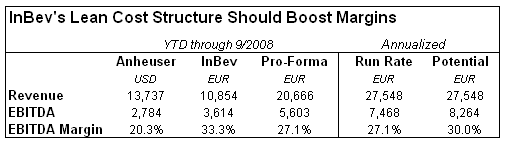
Through the first nine months of 2008, Anheuser-Busch was on pace for annual EBITDA of about $3.9 billion, with InBev tacking on another 5 billion euros. That comes to nearly 7.5 billion euros of annual EBITDA before accounting for any cost synergies. Assuming the A-B portion could see an improvement in profitability due to cost cuts, there is reason to think the combined company could have annual EBITDA of more than 8 billion euros. To see how I get to that number, I have included the following chart:

ahbif.png

Comparable large, dominant, global beverage brands fetch about 10 times cash flow in the public markets so an enterprise value of 80 billion euro is not an unreasonable valuation in my eyes. The catch, of course, is the tremendous debt load InBev took on to become the most dominant beer company in the world.

The companies had more than $7 billion in net debt before the transaction. Even after 20% of the $52 billion load is repaid with proceeds from the new stock sale, Anheuser-Busch InBev remains saddled with about 40 billion euro of net debt, which accounts for half of the projected enterprise value of the company. At the current point in time, that translates into a little more than $24 per AHBIF share. After rising from a low of $14 in recent weeks, the stock trades in the low 20's already.

Is there any upside left then? Well, leverage works both ways. If you take on too much debt and your cash flow sinks, you might be left holding the bag. On the other hand, if your cash flow is strong, you can repay debt fairly quickly. There is no doubt that 40 billion euros of debt sounds like a huge number, but it is more reasonable if you are bringing in 8 billion euro of EBITDA annually.

Now, it is true that all of that money cannot go toward the debt (which would wipe it out in five years), due to ongoing capital expenditure requirements. That said, Anheuser-Busch reinvests about 20% of its cash flow into the business, so they were on pace to have free cash flow of $3 billion in 2008 after reinvesting $750 million back into the business. InBev was even bigger than A-B before the merger, so free cash flow should be immense.

Assuming AHBIF reinvests 20% of operating cash flow into the business and uses the remaining 80% to repay debt, the current 40 billion euro debt load could be reduced by half within several years. At current prices, AHBIF stock could return more than 50% in 3 years, which equates to a 15% average annual return.

I have ignored taxes in this example, but fortunately the company's interest expense will wipe out much of their taxable income. To offset that variable, I also did not factor in any proceeds from asset divestitures that are likely to be completed to help with the deleveraging process. Anheuser's entertainment division (think Busch Gardens, etc) as well as their packaging division are often rumored to potentially be on the selling block. Proceeds would be used for interest and debt payments. As a result, while the numbers I have used will not prove to be exact, a net debt to EBITDA ratio of 5:1, while high, seems manageable given the strength of the combined company's business.

Note: Anheuser-Busch InBev stock trades on the Brussels exchange and recently fetched about 16 euros. Investors without access to international exchanges can buy the stock over the counter under the symbol AHBIF for around 23 dollars, but currency fluctuations will impact the dollar price, which is based on the euro quote and the prevailing exchange rate.

Full Disclosure: Peridot was long shares of Anheuser-Busch InBev at the time of writing, but positions may change at any time