Chad's Stock Idea for the Annual Business Week Investment Outlook Issue

bw-cover-12-29-08.png

The annual Business Week Investment Outlook issue (dated 12/29-1/5) is out and I was asked to contribute a bargain investment idea from the currently depressed market. My pick (on page 58) was Anheuser-Busch InBev. I am on vacation through 12/27 but I will write about this newly created beer giant in more detail when I return. For those of you who do not have access to the magazine, I made a PDF file:

Business Week Investment Outlook - 12-29-08 (Page 58)

Abercrombie Chooses Fewer, More Profitable Sales Over Lower Margin Bargain Bins

Last month I mentioned I thought Abercrombie and Fitch (ANF) stock looked undervalued. A December 8th Wall Street Journal article entitled "Abercrombie Fights Discount Tide" discussed ANF's strategy to maintain its premium brand image by choosing to accept higher rates of sales decline, relative to lower priced competitors, in order to hold up profit margins and not risk losing pricing power when the economy recovers.

The company has taken some heat on Wall Street for employing such a strategy, but it worked just fine for Abercrombie in the last recession. As an investor, I much prefer fewer sales at higher margin to higher volume (and less profitable sales) because it minimizes the risk of a retailer falling into the red.

The WSJ cites November same store sales drops of 28% for Abercrombie versus only 10% for Pacific Sunwear (PSUN) and 11% for American Eagle Outfitters (AEO) as evidence that markdowns boost sales in the short term, which is certainly true. But the key here is margins. While gross margin collapsed for the latter two retailers (Pac Sun from 34% to 29%, American Eagle from 47% to 41%), Abercrombie's held steady at a stunning 66%.

Gross margins of 66% are usually reserved for software and medical device companies, not mall retailers. With retail markups of 50% above cost, Abercrombie clearly has a premium brand. It is expected that during tough economic times that many of its customers will trade down to cheaper clothes, but that does not mean the company should completely rebrand itself. ANF is debt-free with 66% gross margins, so sales can drop pretty significantly without jeopardizing profitability.

"We hear your concerns," ANF Chief Executive Michael Jeffries said during an earnings call, but "promotions are a short-term solution with dreadful long-term effects." Abercrombie's general counsel, David Cupps, added that the company is "well positioned to deal with a tough market," adding that cutting prices would be cutting the quality of merchandise. "We're not going to follow the promotional pied piper," he said.Given the amount of bad news already priced into ANF shares, they look very cheap even if sales continue to drop throughout 2009. Even if you assume earnings fall 50% from their 2007 peak level, never recover at all, and the stock only fetches a 10 P/E, investors buying today will make a 30% return from current levels. That is a risk-reward scenario that looks very favorable.

Full Disclosure: Peridot Capital was long shares of ANF at the time of writing, but positions may change at any time

El Paso Debt Deal Shows High Yield Market Isn't Dead, Just Expensive

To get an idea of how bad the high yield debt market is right now, one need only look at what price El Paso (EP) had to pay this week to issue $500 million worth of senior notes. El Paso is a solid company and should not have trouble selling debt. Their hybrid business model; energy pipelines coupled with exploration and production, makes their cash flow more predictable than more narrowly focused energy companies.

Still, El Paso is paying 12% interest and even with such a coupon rate, could not sell the notes at par. Instead they discounted them to entice buyers, who will earn 15.25% by holding to maturity. Why did EP sell such expensive debt? They have more than $13 billion of debt, with more than $1 billion coming due in 2009, and wanted to refinance until 2013.

Hopefully deals like this will continue. While they do not represent bargains for issuing companies, an increase in corporate debt offerings will be crucial for getting improvement in the corporate debt market. Once it becomes more clear that companies can issue new debt (even at high prices), the pressure on common stock prices of highly leveraged firms will abate, removing one of the largest elements of fear in today's equity market.

Full Disclosure: Peridot was long shares of El Paso preferred stock at the time of writing, but positions may change at any time

Housing Recovery: Long Way Off

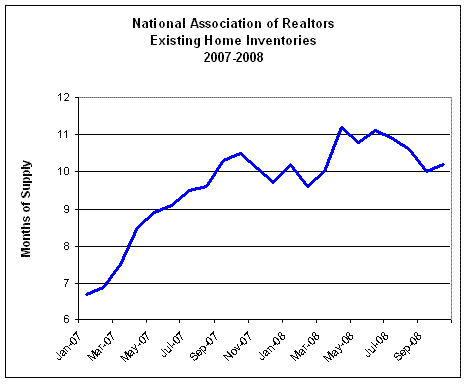
It is going to be very difficult for the U.S. economy to turn a significant corner without a housing market that is at least stable. Amazingly, the housing situation has not improved much at all during 2008, even as builders halt new construction and slash prices on newly built inventory. Increases in foreclosures have completely negated any of those builder actions. As you can see, home inventories remain elevated and have just been treading water all year, well above historical averages.

existinghomesoct08.gif

The Treasury Department is thinking about trying to get mortgage rates down to 4.5% from the recent 5.5%-6.5% range. Will that help the housing market recover? I doubt it (interest rates aren't the problem). How many people can't afford to borrow money at 5.5% to buy a home, but could do so with a 4.5% rate? Not many, I suspect.

Financial, Retail Weakness Mask Underlying Core Profitability

Simply judging from the stock market's performance over the last couple of months, you might think the entire U.S. economy is teetering on the brink of disaster. In reality though, the sheer ugliness of the financial services and retail sectors is masking the other eight sectors of the market that, while certainly weaker than they once were, are actually holding up okay given the economic backdrop. The easiest way to illustrate this is to show earnings by sector for the last three years; 2006, 2007, and 2008. Keep in mind the 2008 are estimates based on nine months of actual reported profits and estimates of fourth quarter numbers.

spxearningsbysector112408.png

As you can see from this graph, earnings in areas like telecom, healthcare, staples, or utilities are doing just fine and can withstand further weakness in 2009 and still more than justify some of the share price declines we have seen in recent months.

The selling has been indiscriminate but the business fundamentals are quite differentiated, depending on sector, which is one of the reasons that the U.S. equity market has not been this cheap relative to earnings, interest rates, and inflation since the early 1980's. It is a gift for long term investors.

Citigroup: A Sell At $3.00?

I really thought we would finally see a less negative view on Citigroup (C) from Meredith Whitney a couple weeks back when the stock hit three bucks. Whitney, you may recall, is the Oppenheimer & Co banking analyst who downgraded Citigroup to "underperform" last year when the shares traded for around $40 each. Last month, Citigroup hit a fresh intra-day low of $3.05, capping a stunning 13 month 92% drop in the shares of what once was one of the most valuable U.S. companies.

What a perfect time that was to remove a "sell" rating. At $3.05, Citigroup stock likely had two possible long term outcomes; go bust or go a lot higher. Whitney could have closed the book on what would have been one of the best analyst calls of all time. It would be easy to justify upgrading Citi to "neutral" at $3 per share. After all, after a 92% drop, the risk-reward trade off is far less compelling unless you really think the company won't survive. Whitney has never indicated she thinks Citigroup will go under, so I have to think recommending investors sell the stock at $3 makes little sense, unless she wants to remain the most bearish analyst on Wall Street and an upgrade of a large bank stock wouldn't fit that mold.

In the past two weeks, Citigroup stock has surged by more than 150% from the ridiculously low $3 quote to $7.70 per share as I write this. If that $3 print turns out to be the low (I am not predicting that necessarily, as I have no idea where bank stocks could trade in the short term), Whitney might have to remove her "underperform" rating at much higher prices, which tarnishes the call because she would have that rating on the stock as it doubled, tripled, or even quadrupled in value.

If the stock goes back down in the coming weeks or months, I think Whitney would be well-served to put a neutral rating on the stock, claim victory, and cement her Citigroup call as perhaps the best sell side recommendation of all time.

It would not be an easy decision given the banking sector still has not overcome its problems, but moving on would signal to investors and her clients that she has not resorted to simply being the most bearish banking analyst on Wall Street. Just because that is what put her on the map, it does not mean staying bearish for too long could not take her off of it just as quickly.

Full Disclosure: No position in Citigroup at the time of writing, but positions may change at any time

Sears Holdings Has Squandered An Opportunity

The last four years or so for Sears Holdings (SHLD) and its shareholders would make for quite an interesting Harvard Business School case study. I have been writing about the company since 2005 and was an early investor in Kmart, even before Eddie Lampert used it as a vehicle to buy Sears.

The early success was very impressive. Lampert bought loads of Kmart debt as it filed bankruptcy and gained control of the company's equity when it reemerged in 2004. In 2006 Sears Holdings earned a profit of $1.5 billion, or $9.58 per share, quite a turnaround for a retailer that had been bleeding red ink.

Lampert accomplished this not by turning Sears and Kmart into strong retailers like Wal-Mart (WMT) and Target (TGT) (sales and profit margins still lagged those competitors), but rather simply by running the companies very efficiently and milking them for cash flow. Even if you earn a 3% margin instead of 6%, that is big money when you bring in $50 billion of sales annually.

The Wall Street community was sold on the idea that Lampert would use the cash flow from Sears Holdings to diversify its business away from ailing retail brands. Maybe he would close down stores and sell the real estate, or lease it back to other retailers who wanted the space. Maybe Kenmore and Craftsman products, which are owned by Sears, would show up on other retailers' shelves. Maybe Land's End, also owned by Sears, would be expanded as an independent retail brand. Maybe Lampert would buy other companies outside of retail altogether. The possibilities seemed, were, and still are, endless.

And yet none of this has materialized. Sears continues to operate as a sub-par retailer and uses excess cash flow to repurchase stock. As the economy has faltered, so has cash flow. Adjusted EBITDA year-to-date has fallen to $700 million, from $1.5 billion last year. The only positive has been the reduction in share count. Sears earned $1.5 billion in 2006, or $9.58 per share. If they somehow are able to earn that much again when the retail environment improves, earnings per share would be nearly $12 per share because of the lower share count. With the stock at $31 today, you can see that the stock would trade back above $100 in that scenario.

But how will that happen anytime soon if Sears continues as is has? It won't, which is why Peridot Capital has been steadily selling Sears stock over the last year. It used to be a very large holding, but is now one of our smallest. Eddie Lampert evidently was convinced he could do more with the retailer's operations even after the low hanging fruit had been picked. That was a bad decision.

As long as the economy remains weak, Sears will likely use it as an excuse for its poor operating results. That is a shame, because they had a perfect opportunity to diversify out of retail and they chose not to, even when it was widely accepted as the right strategy for investors. The truth is, however, that Sears and Kmart are not strong retailers and likely never will be, at least not in their current form.

To me, Sears is in the same exact position as General Motors (GM) right now. They are operationally inferior to their competitors, but refuse to dramatically alter their business plans to adapt to the market. Today the Big 3 CEOs will testify in front of Congress and explain that the economy is the source of their problems. They need annual auto sales of 13 million units to earn a profit, far from the 10 to 11 million run rate we are now facing.

I don't need to tell you that GM's business model is the problem, not the economy. If the U.S. auto market shrinks due to higher job losses and tighter credit standards, managers need to make changes to ensure they can survive in such an environment. In that case, a stronger economy would mean higher profits, not just survival.

I heard a GM dealer on television complaining that he can finance customers with credit scores of 650 or higher today, whereas last year someone with a 550 could get a loan. He implied that the banks were at fault for cutting credit for people with bad credit (the average credit score in the U.S. is 680). Was it not the fact that 550 credit scores qualified for car loans in the first place that got us into this kind of financial crisis? We should give loans to low quality borrowers to save the Detroit auto industry? I think not.

The bottom line is, if your company adapts you will likely be a survivor. When times are bad the weak die out and the strong not only survive, but they come out of the downturn even stronger than they were before. In today's market, when nearly every stock is down tremendously, there are fewer reasons to invest in Sears or GM when you can buy a stronger company like Target or Toyota on sale. When Target fetched a 20 P/E I preferred to buy the more undervalued Sears. Combine disappointing execution by Sears and a 50% drop in Target stock, and given the same choice I will take Target at a 10 P/E, which is what I plan to do.

Full Disclosure: At the time of writing Peridot Capital was long shares of Sears and Target and had no position in GM or Wal-Mart, but positions may change at any time

How Can TheStreet.com Publish This Story?

In a piece written by Glenn Hall, TheStreet.com published an article today entitled "Today's Outrage: Sears Isn't Worth $4 Billion." I had to check my calendar to make sure it wasn't April 1st because I can't believe the editors at a prominent site would publish this nonsense.

Here is how the article begins:

"How can Sears be worth $31.84 a share? Target fetches only $29.54, and JC Penney is down to $16.55. At the other end of the retail spectrum, investors are only paying $6.41 for Macy's, and at the low end, Family Dollar Stores are only trading at $26. Wal-Mart is one of the few higher-valued competitors, with its shares at $53. So I have to ask: Who thinks Sears is better than Target or even JC Penney for that matter?"

I would expect this from a market novice who does not understand that share prices themselves do not indicate which companies are "better" than others (the number of shares outstanding, and therefore the equity market values, are different). But from TheStreet.com? I think Jim Cramer needs to have a talk with his editors over there.

I was planning on writing about Sears today, and will still do so later, but I just had to point this out for those of you who are often a little too quick to act on something you read online. It has become very easy to reach the online masses with one's views these days, given technological advances, but as a result the quality of the content is diluted, and perhaps even more so than I thought.

Full Disclosure: Peridot was long a small position in SHLD at the time of writing, but has been selling the stock steadily over the last couple of years, for reasons which will be explained in an upcoming blog post. Positions may change at any time.

Why Geithner and Summers Represent Change at Treasury

Tim Geithner and Larry Summers were the top two candidates for Treasury Secretary in the Obama administration, and today at noon ET we will officially hear that both are joining Obama's economic team. Geithner will head up the Treasury Department and Summers will be director of the National Economic Council. Having both of these men, rather than having to choose only one, seems to be a great idea and should bode well for future economic policy.

In what might prove to be an important development, we are not installing a CEO into the Treasury Secretary slot. President Bush's record nominating people for this post has not been very impressive, as two of his former Treasury Secretaries were forced to resign, and the jury is still out Paulson's effectiveness thus far. What did those three men have in common? They were all corporate CEOs before heading to Washington.

Paul O'Neill was CEO of Alcoa (AA) for 13 years before he left for the public sector. He resigned after 2 years and was replaced by John Snow, who had been CEO of CSX (CSX) for 15 years. Paulson came along in 2006 after running Goldman Sachs (GS) for 9 years. Obviously being a CEO should not exclude you from consideration for the top job at Treasury, but I think it will be interesting to see if it proves to not be the best resume for the job.

Full Disclosure: No position in AA, CSX, or GS at the time of writing, but positions may change at any time
Remember, Markets Rebound Before Economic Data Improves

As we head into 2009, the economic backdrop looks gloomy. Two important measures in particular, employment and corporate earnings, are set to deteriorate further throughout next year. The unemployment rate has risen from 4.4% to 6.5%, but many are now predicting a peak of 8%-9% sometime in 2009. Corporate earnings will fall for the second straight year in 2008, but many top-down forecasters expect a third year of declines. Does that mean stock prices have a lot further to fall still? Not necessarily.

Remember, the stock market is a discounting mechanism. It reflects future events ahead of time, as the 50% decline over the last year or so reflects. At some point, stock prices reach levels where they already are reflecting the assumptions of continued weakness in unemployment and corporate earnings. Bill Hester, of Hussman Funds, helps to shed light on this concept. He writes:

"The four-week moving average of the jobless claims data breached 500,000, which has happened only 4 other times. It occurred in December of 1974, in April of 1980, in November of 1981, and in March of 1991. During the 12-month period following these periods, the S&P rose 32 percent, 30 percent, 20 percent, and 9 percent, respectively. These periods also shared attractive valuation. Over the four periods the price-to-peak earnings ratio averaged 8.75, which is about right where the market's current valuation is. Although it's a small sample, low valuation, coupled with economic data confirming a substantial contraction in the labor market, has offered longer-term investors very strong average returns.

Those returns aren't restricted to bull markets that follow the worst recessions. Returns following all of the recession-induced bear markets have been quite strong. First-year returns following a recession have averaged 37 percent with surprisingly little variation. Not including the out-sized gains following the 1982 bottom, all of these first-year bull markets gained between 29 and 44 percent."

Even if we assume, as the market has already begun to grasp, that both employment and earnings don't trough until mid or late 2009, we should not assume that the market will not hit bottom until those numbers stabilize or improve. Examining market history shows that the market rebounds before the economic data signal the recession has ended. As always, the market is a discounting mechanism.

Now, I don't know if the economy will bottom in early 2009, mid 2009, late 2009, or during 2009 at all. As a long term investor, I don't find it very helpful to try and guess between outcomes that are only a quarter or two away from each other. Even Nouriel Roubini, the biggest proponent around of a doomsday economic scenario, thinks the recession will end by the end of 2009. Even if you believe in his forecast, the market would start a new bull market in Q3 or Q4 of 2009 (3-6 months before the recession ends, as history suggests). If he is proved a bit pessimistic, it could be even sooner than that. As a result, long term investors should be buying, not selling at this point. Equity market valuations are too low to make the case that the market has not yet discounted most of the bad news we are likely to get in coming quarters.