Lampert, Sears Make Play for Restoration Hardware

Just days after I wrote about the focus at Sears (SHLD) being store redesigns, not non-core asset sales, we get a timely SEC filing from the company announcing its interest in bidding for home furnishings retailer Restoration Hardware (RSTO). The comments from Sears are very interesting. Chairman Eddie Lampert has been eyeing the company since June, and this month alone has increased his stake by 3.4 million shares, bringing SHLD's total ownership to 5.3 million shares, or 14%.

In case you didn't read the filing, here is what we know. Lampert indicated his interest in acquiring or partnering with RSTO in June, but he did not meet with management to discuss a deal until October. At that point he offered $4.00 per share for RSTO, which was 40% above where the stock was trading. RSTO indicated that price was too low, but Lampert insisted on conducting due diligence before raising his bid.

On November 8th, RSTO announced a management led buyout (along with private equity firm Catterton Partners) in a deal worth $6.70 per share in cash. However, RSTO stated publicly that it will consider other offers until December 13th, and that it plans to actively solicit such alternative deals during that time. Lampert appears eager to sign a confidentiality agreement in order to look under the hood and perhaps make a revised offer.

Obviously, a lot is going on here. The market's reaction has been largely negative, but it appears that is mainly based on the short term retail environment being bad for home furnishings. Lampert is clearly not concerned with how well RSTO will do in Q4 or 2008. He is likely looking long term, trying to come up with ways to strengthen the product and profitability of Sears merchandise in a more normal retail environment.

So what is the rationale for an interest in RSTO? To me, it's not that complicated. Lampert has said repeatedly since he took over Kmart, and subsequently bought Sears, that his first priority was not growing the company, but increasing profits. Retail experts and many investors have complained about lack of store growth and negative same store sales growth, but they are missing Lampert's point.

See, Lampert doesn't think the problem is lack of sales or not enough customers. Sears has thousands of stores and more than $50 billion in annual revenue. The problem is, despite such a strong retail presence, the company makes very little money. In his mind, he can do one of two things. One, open more stores that hardly turn a profit, or two, maximize profits from the existing store base and then figure out how best to grow the business. Not surprisingly, he prefers the latter because he is an investor in the business. Remember, long term stock prices are dictated by profits, not sales.

How would RSTO fit into this model? First, Lampert is buying a cheap retailer during a time when home furnishing sales are weak, so he has upside with the current strore base (100 plus locations). More importantly, he can add better merchandise to thousands of his existing stores. Not only could those products potentially sell better than the ones they have now (RSTO's product is a very high quality), but they are far more profitable because Sears would own the suppler.

Lampert seems to be focused on building store redesigns around promoting certain well known brands, many of which Sears actually owns (think Kenmore, Land's End, etc). If the goal is to maximize profits, this model makes the most sense. Consumers have multiple avenues to purchase company-owned products. You can buy Land's End clothing through the catalog or in Sears stores. There is tremendous potential to boost sales and have the cost structure lower at the same time. The same could be done with Restoration Hardware.

So, although the reaction to this news has hardly been positive, I think that is simply because people don't believe in Lampert's strategy. However, if you are investing in Sears alongside him, you have to be pleased that he has done exactly what he said he would do. Either investors want in to the plan, or they don't. That's what makes a market.

Whether or not the plan works remains to be seen, but Lampert's track record to date has been pretty impressive. Although the stock is down significantly from its highs, along with all other retail stocks, investors need to keep in mind it was $15 per share when he started this whole retail endeavor. As for the most recengt news, we should know the fate of RSTO shortly, as the company has about three more weeks to field competing offers.

For those who were wondering if Lampert was up to anything on the acquisition front, it was very interesting to learn that he has been eyeing RSTO since June. Not only that, but he likely first bought shares back then at prices below $3, versus the $7 price tag today (the SEC filing noted that SHLD has owned 1.9 million shares for longer than 60 days). That kind of return is exactly the type of thing Lampert fans have been hoping for and RSTO might just be the beginning.

Full Disclosure: Long shares of Sears Holdings at the time of writing

Store Redesigns, Not Asset Sales, Top Lampert's Priority List for Sears

Investors hoping Sears Holdings (SHLD) Chairman Eddie Lampert would quickly move to transform the company into more than just a retailer have been disappointed. Lampert clearly understands the tremendous value of his company's assets, but thus far has not moved to revamp the company as much as his supporters would have liked. Instead, Lampert seems convinced that he can boost the company's retail operating margins closer to industry averages with better management of the store base.

In fact, a press release issued Saturday sheds light into Lampert's game plan:

Kmart Store Becomes a New Sears

MARIETTA, Ga., Nov. 17 /PRNewswire/ -- The former Kmart at 4269 Roswell Rd is now a brand new Sears. Local Atlanta residents can expect a one-of-a-kind shopping experience that offers an expanded selection of merchandise including more national brands than ever before and a 23,000 sq. ft. Lands' End shop featuring the largest selection of Lands' End merchandise ever at Sears.

The new Sears will come to life by offering customers a "store-of-shops," and a fresh design layout with different flooring, fixtures, and displays. Marquee brand names now found in the new Sears include Sony, Hanes, Workwear - by Craftsman, Carhartt, Timberland and Diehard apparel, Levi's, and Nordic Track. The store will also feature expanded Home Electronics and Home Appliance showrooms, organized around favorite manufacturers, that will also help customers choose the right look, feel and function with other brands Sears carries.

A newly remodeled hardware department will feature innovative and interactive Garage Organization, Mechanics and Carpentry shops to help customers find the right item quickly and efficiently.

Five central internet workstations located throughout the sales floor will provide free high-speed Web access to enable both the customers and associates to quickly access the internet, verify prices, shop online and contact store personnel if help is needed.

The store will also carry a wide range of convenience items previously available at the former Kmart location including full pharmacy services, health and beauty, cosmetics and greeting cards.

This new format will help customers create the look they want and find the gifts they need all in one convenient location. Shoppers will find the quality brands they have come to know and love like Diehard, Craftsman, Ty Pennington, and Kenmore plus extended assortments of national brands from Nordic Track, Schwinn, Reebok and more. Customers can also shop for great fashions with the first 23,000 sq. foot mega Lands' End shop that brings the legendary brand to life with items for women, men, kids, baby and home. Now families can touch and feel the quality and see the details of Lands' End products. A special monogramming service is also available to easily personalize just about any Lands' End item that will take a stitch. There's even free shipping on any catalog or landsend.com order placed from the store.

It remains to be seen if Lampert can boost profit margins further at Kmart and Sears. Initial attempts were successful, but 2007 has brought little improvement, due in part to the weak retail environment in both the low end consumer and home improvement/furnishing markets. That has resulted in Sears stock being down 28% year to date.

This press release is further evidence that Lampert is focused on improving store margins, not diversifying business lines. As a result, it indicates that the Sears investment thesis remains a long term story. By the way, if anyone lives near this redesigned store in Atlanta, I'd be curious to hear your thoughts on the new store.

Full Disclosure: Long shares of Sears Holdings at the time of writing.

Forget Writedowns, Bank of America Gets $16B Writeup!

From the Financial Times:

BofA set to gain $30bn on CCB stake

Tuesday Nov 13 2007

Bank of America (BAC) on Tuesday said it was sitting on a potential gain of more than $30bn on its investment in China Construction Bank, highlighting the paper profits some western banks have made on holdings in their Chinese counterparts.

BofA paid $3bn two years ago for an 8.5 per cent stake in CCB and an option to increase to 19.9 per cent at a very low price. The bank plans to record a gain of about $16bn on its existing stake in the fourth quarter.

"On paper we have a potential gain in excess of $30bn," said Joe Price, BofA's chief financial officer, adding that it would be able to cash in some of its holding over the next 2 to 3 years.

Not only does BofA have less subprime mortgage and MBS CDO exposure than other big banks, but they also have done some smart things which will certainly help them weather the storm.

Full Disclosure: Long shares of Bank of America at the time of writing

As Usual, Bill Miller's Letter is a Good Read

I've been a follower of Legg Mason's Bill Miller for a long time. Having grown up in Baltimore, where Legg Mason is based, I was able to learn a lot about him and his investment strategy before most others did so via the publicity surrounding his stunning 15 straight years of beating the S&P 500 index. Miller is a contrarian, value investor, just as I am. And although I don't always agree with his stock picks, his insights into the market and long term investing are particularly well written. I even quote him on Peridot Capital's web site, because he is far more articulate that I am when addressing many important investment concepts. You can usually learn something by reading an article about him, or his actual letters to investors, which are published every 3 months.

Last week, Miller's third quarter commentary was especially insightful, as it addressed many of the turbulent events of the recent past and explained how he views the current marketplace. I've provided a link to Miller's third quarter letter to investors for those of you who are interested. I suggest that long term contrarian investors add the letters to their personal reading list on a quarterly basis.

Crocs Stopped Dead In Its Tracks

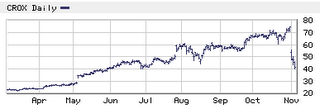
If you've ever owned a momentum stock, you know that things are a lot of fun, until the company misses a quarter. Investors' love affair with trendy footwear maker Crocs (CROX) ended last week, as the company's third quarter earnings release left much to be desired for the momentum traders hoping for yet another blowout quarter. The stock has been crushed to the tune of 45% in just 3 trading days and now fetches $41 per share, down from its high of $75.

CROX.png

After such a move, it appears that there might be an investment opportunity here if you have a good understanding and expertise of trendy fashions. For such opinions, I am not your guy, as I have no idea what the future for Crocs will look like and won't even fathom an uneducated guess. Lots of people surely think the company's shoes are merely a fad. However, if you disagree with that, you might want to take a look at the shares as an investment.

Here's why. Last week Crocs issued 2008 guidance of 35-40% sales and earnings growth but that was not enough to keep the stock from tanking. If you believe in the Crocs story (that the company can continue to grow from here), the stock is only trading at 15 times the $2.70 earnings guidance the company has issued for next year. If 2008 will indeed bring investors 35-40% earnings growth as predicted, and the company can grow (at all) in the years after that, buying Crocs today around 40 bucks will actually prove to be a wise decision. I don't know enough about shoes to feel confident in that view, but I bet some people do. If so, the stock might finally be reasonably priced.

Full Disclosure: No position in CROX at the time of writing

Alright Bernanke, Enough with the Rate Cuts

Do you get the feeling that FOMC Chairman Ben Bernanke is lowering interest rates more because that is what the markets want, and less because it is actually helping the problems we have in the housing and credit markets? The debate has long been whether or not the mortgage crisis will be contained or spread into the rest of the economy and cause a recession. With third quarter GDP growth coming in at 3.9%, the highest rate since early 2006, it is clear that the economy is a lot more than just the housing market.

While GDP growth should slow meaningfully in Q4, it does appear the mortgage problems are contained. Unless rate cuts will help stabilize the housing market, which is not a likely result, I don't see the need to go ahead with them just for the market's sake. After all, commodities like gold, oil, wheat, corn, etc are soaring. The result will be higher prices for consumers, which we have already begun to see as companies like FedEx, Colgate, and Procter & Gamble are all raising prices to maintain their profit margins and stock prices.

In the face of apparent inflation pressures, interest rates could ultimately be headed higher, which would make the recent cuts even more baffling. It's true that the government's inflation data doesn't seem to jive with reality, and maybe that will reduce the likelihood that rate increases are in our future, but when press release after press release announce price increases from major manufacturers due to record commodity prices, it's hard to deny inflation is real.

So what will cure the housing market's woes if rates cuts won't do the trick? Honestly, just the laws of supply and demand. The housing market is still falling with no signs of stability in sight. As long as delinquency and foreclosure rates continue to rise, and home prices continue to fall, the credit market issues (loan losses and asset backed securities writedowns) will continue. The value of loans won't stop falling until the performance of such loans improves, or at least stop deteriorating.

Rate cuts won't help because they have no direct impact on home prices or mortgage delinquency rates. This will be apparent when we see fourth quarter loan performance continue to get worse, not better. As home inventories are worked off and more home owners refinance into fixed rate loans, the markets will eventually stabilize. It will take time though. I don't know when, nobody does, but hopefully we can get there by the end of 2008.

As for whether the housing market weakness has spread to other areas, this debate obviously will continue. From third quarter earnings season we see that the weakness has really been contained to home builders, mortgage lenders, banks and investment firms that own securities backed by mortgage loans, and companies that provide insurance for mortgages and mortgage backed securities. It is my belief, and many will certainly disagree, that consumer spending is not as bad as some would have you think, and the fact that growth in spending is lackluster has much more to do with the face that real wages have been stagnant for years, and not because of the housing market. In addition, the fact that consumers are staying current on all their other monthly bills, even when they are delinquent on their mortgages, shows that the housing market's issues really are fairly well contained.

As for policy moves, I think actions should be focused exclusively on stabilizing the housing market. While pleasing to the markets, I don't see any direct impact on housing from rate cuts. Just imagine how great it would be if we could get back to a "normal" housing market. People would have to get used to not making much money on their homes (real estate returns historically don't outpace inflation), but the credit markets would stabilize and corporate earnings could resume their growth trend. Even a flat housing market would be welcomed by investors, to say the least.

Full Disclosure: No positions in the companies mentioned

The Implications of Negative Earnings Growth

Undoubtedly, the underlying driver of the U.S. stock market in recent years could be summed up in two words; earnings growth. Equities now face a hurdle, however, as third quarter profits for the S&P 500 could very well decline year over year for the first time in five years. The implications for the market are pretty important.

At the outset of the year, market forecasters were calling for low to mid double digit returns for the market, supported by rising earnings and slight multiple expansion. It was my view that multiple expansion was unlikely (due to a lack of low P/E ratios to begin with, coupled with decelerating economic and earnings growth rates), so market returns would more likely track earnings advances, which would put us up in the mid to high single digits for the year. The S&P 500 is slightly above that pace right now, but it will likely be an uphill battle from here.

The reason is that without multiple expansion or earnings growth, there is no way for the market to advance meaningfully, by definition. The end result is likely to be a range-bound market as judged by the major indices. In fact, as the chart below shows, we have already begun to see this scenario take shape.

S&P 500 Index - Last 6 Months

From an investor perspective, this infers that stock picking will be all that more crucial to achieve investment gains. Not surprisingly, I would suggest focusing on individual situations where either multiple expansion or earnings growth are largely assured. The ideal investment candidate would be set up nicely for both, which would allow for solid gains regardless of whether or not the overall market advances meaningfully in coming months.

Countrywide Predicts Trough, Shares Soar 24%

Gauging the outlook for pure mortgage lenders like Countrywide (CFC) is a tough game and one that I am choosing not to play. The company is predicting that the third quarter was the trough and profits will return in Q4 and 2008, but nobody really knows for sure. Delinquency rates are still rising at CFC, standing at 7.1% as of September 30th, up from 5.7% three months before.

Until there are signs of stability and that stability hangs around for a while, I'm not going to bottom fish in mortgage-related companies like pure lenders or mortgage insurers. Honestly, those stocks are down so much, trading far below even recently slashed book values, that I think eventually there will be plenty of upside without even needing to time the bottom of the cycle.

Until then, I continue to like the bigger diversified banks with fat dividend yields. With these stocks yielding more than treasury bonds, I think you can justify buying low and being patient, knowing that calling a bottom is essentially impossible. I would, however, start making a list of the kinds of stocks you might want to target when things start to rebound. You won't be able to time a purchase perfectly, but there is no way that most of the home builders, mortgage insurers, and big lenders won't survive and be consistently profitable when the markets get back to some sort of more typical environment.

There will be money to be made, but I'm not comfortable jumping into pure plays just yet. Hopefully by sometime in 2008 things will stabilize and we'll have a better idea of what "normal" conditions look like. At that point, making bets will be much more prudent.

Full Disclosure: No position in Countrywide at the time of writing