Time Warner Completes Cable Spin-Off, Sets Stage For AOL Split Next

Time Warner (TWX) has long been a media conglomerate difficult for investors to dissect. However, that may be about to change and the moves could finally extract some value for Time Warner shareholders. The company will complete its spin-off of Time Warner Cable at the end of the month, which offloads billions of debt to the cable company and frees up cash flow at TWX.

Time Warner is also making some moves at its AOL division. AOL has hired Tim Armstrong, formerly the head of U.S. sales at Google, as its new CEO. The conventional wisdom is that Time Warner will spin off AOL as well, in order to allow Armstrong to maximize profit and growth potential at the online unit.

All of this should be good news for Time Warner shareholders, whose stock has been cut in half over the last year and sits near its lows. Time Warner retains some very strong brands, including HBO. With less debt from the cable division, coupled with a $9 billion cash infusion from the spin-off and a new strong management team at AOL, investors might finally begin to look at the stock again in the intermediate term.

As a result, bargain hunters who prefer strong large cap companies might be interested in checking out TWX shares at $8 each. Not only do they sit near their lows, but they yield 3% and trade for less than 5 times trailing cash flow.

Full Disclosure: No position in TWX at the time of writing, but positions may change at any time

Merrill Lynch's David Rosenberg Gets Less Negative

For those of you who don't know Merrill Lynch chief economist David Rosenberg, he has been very bearish on the U.S. economy for a long time, long before the recession hit. Some give him credit for predicting how things would play out, while others criticize the fact that he was years early and therefore missed a lot of the upside before being right about the drop. Both points are reasonable, but I bring his name up because he was on CNBC this afternoon sounding much less bearish than any other time I can remember. Not bullish (heaven forbid), but not all that negative either.

Rosenberg pointed out that the stock market typically bottoms out about 60% to 65% of the way through a recession, which by his projections means we are about 90% of the way through this bear market. His downside target for the S&P 500 is 600, but he oddly adjusted that downward after his original level of 666 was reached "too early." He gets to 600 by taking $50 of earnings and applying a 12 multiple. As you can guess for my recent writings, a 12 P/E on trough earnings is much more reasonable in my view than some of the single digit predictions of other strategists.

I typically don't put too much weight in the absolute predictions of either the most bullish or most bearish people on Wall Street because both groups tend to stay in their respective camps far too long (Meredith Whitney comes to mind). That said, when long term bears begin to get more positive, it says a lot for where the market and economy are. If you can get people who hated stocks and panned the future prospects for the U.S. economy, to become even mildly bullish, I think that says something about how much negativity is priced into equities.

Historical Data Disproves "Trough P/E Multiple on Trough Earnings" Myth

Doug Kass, a hedge fund manager dedicated to short selling and frequent guest on CNBC, made a call on the air Monday that the S&P 500 could make its lows for the year this week. A bold call indeed, given that Doug is a short seller and has been correctly bearish on the economy's prospects for a long time. His reasoning is mostly based on extreme pessimism (not unlike in November when we made a short-term low) and low valuations.

Other commentators debate the valuation point. CNBC's own Bob Pisani made the case that assigning a 7 or 8 P/E ratio (a typical number at bear market bottoms) to this year's depressed earnings level forecast (currently around $50 for the S&P 500) is reasonable. Pisani concluded that unless you think that earnings in 2009 will be substantially above $50 (which is very unlikely), the market is not cheap because 7 or 8 times $50 is 350-400 on the S&P 500 index, versus today's sub-700 level.

When Kass was on the air on Monday he rightly suggested that putting a trough P/E on trough earnings is not appropriate, but market commentators continue to insist that is where the market needs to go before a cyclical bottom can be put in.

I have argued against this logic on this blog before (sorry to keep harping on it), but I decided to dig up some evidence on this topic so perhaps we hear less of it in the future. Below you will find the earnings of the S&P 500 relative to the level of the index from 1970 through 1985, a time period that encompasses both the early 1970's recession and the early 1980's recession, both if which are similar in depth to what most believe will be our fate this time around.

peratioduringrecession.gif

From this data you can clearly see why everyone is using a trough P/E ratio of between 7 and 8 times earnings (the bear markets bottomed at a 7 P/E in 1974 and at 8 in 1981). The year of both market bottoms is in boldface to show these levels.

The key here is to look at the level of S&P 500 earnings during both 1974 and 1981. Although the stock market traded at the trough P/E ratios during those years, earnings were at record highs both times! The 1974 level of earnings ($9.35) had never been reached before. The same goes for 1981 earnings ($15.18). Therefore, the idea that we take trough earnings and apply trough P/E multiples is simply unfounded if we look at the very data people have supposedly been using.

Not surprisingly, I am far from the first person to point this out. John Hussman, former professor of economics and international finance at the University of Michigan, actually has created a more relevant P/E ratio called "price to peak earnings" which suggests that trough P/E ratios on previous peak levels of earnings are far more reliable bear market valuation tools.

Where would this type of P/E ratio peg the bottom of the current bear market? Well, S&P 500 earnings peaked at $87.72 back in 2006. Multiply that figure by 7.3 and 8.1 and you get a range for the bear market trough of between 640 and 710 on the S&P 500 index. Interestingly, especially given comments from Doug Kass predicting a possible yearly low this week, the index is in the 680's currently, which is right in the middle of that projected range.

Hopefully actual data is enough to debunk seemingly popular myths about bear market low valuations for the stock market. While this evidence does not make it impossible for the S&P 500 to dip to 400-500, it would make such a move unprecedented in terms of the last four decades of market history, during which we have seen two recessions that are proving to be very similar to this one.

How Bank Solvency Can Be So Hotly Debated

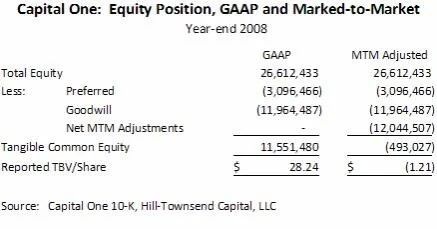
I wanted to pass along some excellent work by Gary Townsend of Hill-Townsend Capital on how there can be such a hot debate on Wall Street about the solvency of our nation's large banks. Essentially, it comes down to this: if you take loans on bank balance sheets and mark them to market, you can show that the bank is insolvent. Of course, bank loans held for investment are not marked to market according to GAAP (instead loan loss reserves are set aside over time to cover future losses), but why let some silly accounting rules get in the way of bank solvency analysis!

Here is a graphic put together by Townsend to illustrate how a bank (in this example, Capital One, a Peridot holding coincidentally) can be very solvent under GAAP but insolvent if you mark every loan on its book to market.

cofsolvency.jpg

Gary comments on the data above by adding the following:

"So with full-bore MTM treatment of Capital One's balance sheet, after net MTM adjustments of just over $12 billion, the company's tangible book value of $28.24 per share falls to minus -$1.21. There are innumerable other examples.

The point is that the market takes Capital One's MTM disclosure, does the math, and values Cap One as if the loans were marked to market anyway. That's how Capital One and many other banks are well-capitalized according to GAAP and regulatory standards, but insolvent in the view of many market participants. GAAP results become irrelevant. And it's how Roubini and others come up with their huge loss numbers, on their way to declaring the U.S. banking system insolvent.

The problem, of course, is that the MTM results have little to do with the intrinsic value to a bank of a loan or a security that it plans to hold to maturity. In a bank, the decline in a loan's value is offset with a forward-looking provision for loan losses. The decline in the loan prices net of loan loss allowances is not due to credit deterioration; it's the result of the distortions and speculation in the world's financial markets. Mark-to-market accounting isn't improving the transparency of bank accounting. It has reduced it, with enormous and growing damage to our economy and prospects."

Full Disclosure: Peridot Capital was long shares of Capital One at the time of writing, but positions may change at any time

Why Not Just Sell And Wait For Rosier Days?

I was emailing with a client yesterday and during the course of the conversation he asked the following:

"Are you overloaded these days? It seems to me that right now all we can do and should do is wait....there's still more downhill. I understand your investment philosophy does not concern itself with short term events, but still...shouldn't there be an exception if you have reasonable expectations that the market will sink more before it bounces?"

Since it is a good question, and one others may be wondering about, I thought I would elaborate here rather than just respond privately.

This client is right, I am not a market timer and do not base investment decisions on what the stock market may, or may not, do over the short term. If the market's short-term direction merely correlated with economic activity this would not be a wise philosophy. We would all simply sell our stocks when the recession began and wait until it ended before getting back into the market.

The reason why market timing is so difficult (and why I choose not to partake in it) is because the stock market is not a proxy for the economy over the short-term. The Dow didn't drop 300 points on Monday because the economy got worse, and the next time it goes up 300 points it will not be because the economy got better. There are so many crosscurrents that affect day-to-day stock market movements that it makes it very hard to guess which way things will go, even during a severe recession.

As an example, consider the last three months. If you asked economists and market watchers how the economy did over the last three months, there would be a consensus view that it has been bad and is getting worse. As a result, one might conclude that stocks would simply drift lower day after day, week after week, month after month, because there is no evidence that the economy is improving.

If we look at market data, however, we see that the S&P 500 rose by 27% between the lows made on November 21st (741) to the highs made on January 6th (943). Did the economy improve during that time? No, it got worse.

Since January 6th the S&P 500 has dropped from 943 to 700, a loss of 26%. What explains this move down? A bad economy? Probably not entirely, given that it has been bad the entire time despite two dramatic (and equally substantial) market moves in opposite directions.

We could make a list of at least a dozen reasons why the market rose 27% over a six week period, only to fall 26% over the next eight. All of those factors combined determine the short-term movements in the market and personally, I find them oftentimes irrational and highly difficult to predict.

To further illustrate the point that markets and economies don't always move in tandem, consider the last recessionary period of this magnitude that our country faced, 1980-1982. Look at how the stock market fared during this three-year period compared with key economic figures such as GDP growth and unemployment:

1980to1982data.png

Does the above data make any sense on its own? Not really. After all, the market rose significantly in the years the economy declined and fell during the year it rebounded temporarily. Joblessness rose consistently over the entire period. Simply assuming that the market will stay bad if the economy stays bad is too simpleminded for such a complex marketplace. There are so many variables that play into it, it could give you a headache trying to make sense of it all.

As a result, I choose to simply focus my time on researching individual companies, their long term prospects, and their share price valuations. There are plenty of people who prefer to focus on other things, and that's fine, that is what makes the market. We are all looking at the exact same data and still come to many different conclusions or choose to focus on different data points entirely.

As a long term investor, I am investing in a world where the stock market rises in any given year about 75% of the time. Not only that, but sometimes it goes up dramatically even when the economy sucks (as the data above shows). Over the long term, historical data has shown that there is a direct, inverse correlation between current share price valuation and future share price returns. Over the short term, stock prices are dictated by any number of factors and the near-term movements are anyone's guess quite frankly.

I prefer to stick to one aspect of stock market analysis. That is just my preference, it doesn't make it right or wrong, it's just what I am good at and have confidence in. Other market participants prefer to ignore the things I look at and focus on those that I ignore. Thank goodness for that, because without that discord, there would be no market for us to participate in, and it certainly would not be inefficient enough to present compelling investment opportunities for all of us to try and profit from.

Proposal To Eliminate Government Subsidies Hammers Sallie Mae

Shares of student lender Sallie Mae (SLM) are down 42% this morning after the Obama Administration's newly unveiled budget included a proposal to eliminate government subsidies paid to private banks who make student loans. The subsidies, which cost the government billions each year, would cut government spending by $47.5 billion over the next 10 years. Wall Street is outraged, claiming that getting rid of the subsidies will drown out private student lenders and increase the market for government loans (and therefore government involvement in our economy).

I'm confused. I thought we all want a free market capitalist system? If private student loans are unprofitable (and therefore require government subsidies in order for banks to offer them), wouldn't the free market dictate that private student lending is not a worthy endeavor for private, profit-seeking banks? Maybe I'm missing the point, but I think reducing any government subsidy, and therefore the budget deficit, would be a good thing, especially for proponents of the free market.

As for the argument that this measure would virtually eliminate private student lending, I guess I'm not convinced. Given how creative and entrepreneurial our private industry is, do we really think they can't come up with a student lending program that is both attractive to the borrower and also profitable for the lender? I have no doubt that the banks would love to keep getting these subsidies, but the notion that student lending in the private sector can't be maintained without them seems a bit extreme, and even if that is the case, maybe private lending is a flawed model.

What do you think?

Full Disclosure: No position in Sallie Mae at the time of writing, but positions may change at any time

With Banks Cutting Common Stock Dividends, Look At High Yielding Preferreds

If you're a bank that took government TARP funds, whether you asked or were forced to take them, you better be very careful about paying for travel or entertainment for any of your employees or clients. Latest example: Northern Trust (NTRS), a custodian bank that had the nerve to send people and entertainment to the Northern Trust Open golf tournament. Of course, now people are irate because NTRS took $1.6 billion in TARP money and is now "using taxpayer dollars to throw parties."

Don't be shocked if they give the money back very soon. Northern Trust is not your typical lending institution, but instead focuses on back office services for financial services firms. As a result, the company is actually doing very well and continues to make good profits even in this environment. The company didn't want or need TARP money, but former Treasury Secretary Henry Paulson didn't give them a choice, he made them take more than a billion dollars.

We are now hearing that many banks (those that took TARP funds) are cutting the dividend on their common stock to one cent per share per quarter, thanks to the new wave of government involvement in the management of these firms. Since many investors rely on dividends for regular income, and some banks tried to reject the government money and the accompanying scrutiny, these dividend cuts are tough to stomach for the healthier firms and their investors.

There are alternatives though, namely the publicly traded preferred stock of these banks, which pay lofty dividends and aren't in danger of being cut because the government is getting paid interest in the form of preferred dividends. There is no way Treasury will make banks cut its own dividend payment, so as long as a bank is relatively healthy and is in little danger of being the next victim of the credit crisis, investors can dip their toes into the preferred stocks of the stronger banks.

Not only are these preferred shares trading at large discounts to par value, but the dividend yields range from 10% to 15% in most cases. In order for a bank to stop paying preferred dividends, it really has to be in bad shape, so if you are looking for high dividend yields in the banking industry, look at the preferred stocks of those banks you think will survive the current mess.

Full Disclosure: No position in Northern Trust at the time of writing, but positions may change at any time

No, Canada Isn't Evil

Did you know that more North American cars are manufactured in Ontario than in Michigan?

Unfortunately, our country's political tensions are so elevated that anyone who even suggests the possibility that another country may do something better than the U.S. is labeled unpatriotic. Of course, those suggestions are made because the person making them cares deeply about our country's future, but that point often gets ignored.

Fareed Zakaria of Time Magazine penned an interested piece in the 2/16 issue entitled "The Canadian Solution." In it he points out several areas in which Canada's government policies appear to be working better than ours. Maybe if we finally can admit that not everything we do in the U.S. turns out to be perfectly right, we can begin to at least consider other kinds of policies without being labeled un-American.

It became clear from President Obama address last night that healthcare reform will be on his agenda in 2009. A likely focus for such reform will be making sure that every American has health insurance. Such a task will undoubtedly be bad-mouthed by many, labeled as socialism.

"Let the free market work, we can't be socialists like Canada and France!," they'll say. The free market is usually great, but if you have been diagnosed with a disease and lose your job and employer-based insurance plan, you often can't turn to private health insurance provided by the free market. Either the insurance company will refuse to cover you at all (because they won't make a profit on someone who is sick), or they'll charge you a few thousand dollars a month, which obviously you can't afford. The free market works most of the time, but not all of the time, as the sub-prime bubble has taught us so well.

Zakaria's article uses evidence from Canada to try and show us that sometimes other countries get things right more often that we do. Simply pointing out facts does not make Zakaria unpatriotic, it simply suggests that he believes we should keep an open mind about certain important issues. After all, if our system isn't working very well, but we refuse to adopt the ideas of other countries, then how can we ever expect to make improvements?

Below are some excerpts from Zakaria's article:

"Guess which country, alone in the industrialized world, has not faced a single bank failure, calls for bailouts or government intervention in the financial or mortgage sectors. Yup, it's Canada. In 2008, the World Economic Forum ranked Canada's banking system the healthiest in the world. America's ranked 40th, Britain's 44th."

"Canada has also been shielded from the worst aspects of this crisis because its housing prices have not fluctuated as wildly as those in the United States. Home prices are down 25 percent in the United States, but only half as much in Canada. Why? Well, the Canadian tax code does not provide the massive incentive for overconsumption that the U.S. code does: interest on your mortgage isn't deductible up north. In addition, home loans in the United States are "non-recourse," which basically means that if you go belly up on a bad mortgage, it's mostly the bank's problem. In Canada, it's yours."

"Ah, but you've heard American politicians wax eloquent on the need for these expensive programs (interest deductibility alone costs the federal government $100 billion a year) because they allow the average Joe to fulfill the American Dream of owning a home. Sixty-eight percent of Americans own their own homes. And the rate of Canadian homeownership? It's 68.4 percent."

"Its health-care system is cheaper than America's by far (accounting for 9.7 percent of GDP, versus 15.2 percent here), and yet does better on all major indexes. Life expectancy in Canada is 81 years, versus 78 in the United States; "healthy life expectancy" is 72 years, versus 69. American car companies have moved so many jobs to Canada to take advantage of lower health-care costs that since 2004, Ontario and not Michigan has been North America's largest car-producing region."

Why Letting Citigroup Fail Could Cost Taxpayers Hundreds of Billions of Dollars

Why has the government injected $45 billion into Citigroup (C) rather than simply let it fail? Believe it or not, because of how much it might cost the taxpayer to do so. I know that might sound backwards, but consider the largest bank failure so far, IndyMac.

IndyMac had $32 billion of assets and its failure cost the taxpayer a whopping $9 billion (remember, the government insures customer deposits should a bank fail). Well, Citigroup has more than $2 trillion of assets, which makes it about 64 times larger than IndyMac. While the numbers won't be exactly proportional, if you multiply 64 by $9 billion you get an estimated cost to the taxpayer, in the event Citigroup fails, of a staggering $570 billion.

Considering the FDIC insurance fund stood at $35 billion at last check, you can see the government doesn't have the money to let Citigroup fail. That is probably one of the reasons why they might prefer to provide aid to Citigroup in exchange for an ownership stake. It is conceivable that would be far less costly to the taxpayer to keep them afloat than it would be to let them fail.

Full Disclosure: No position in Citigroup at the time of writing, but positions can change at any time

CNBC Documentary by David Faber, "House of Cards," Is Worth Your Time

One of CNBC's finest, David Faber, recently completed a two hour documentary about the housing bubble and the credit crisis. I had the chance to watch it on Sunday and it is very well done. For those of you who are interested in how the combination of mortgage brokers, Wall Street, and consumers led to the dire financial predicament we find ourselves in right now. Faber really hits on all of the major culprits and explains them well along with his superb guests.

CNBC replays House of Cards in prime time during the week and over the weekends. According to my Comcast program guide, the next airing is Wednesday from 8-10pm ET but check your local listings and set your VCR or Tivo.