Will the Fed Really Cut Rates Twice in a Week?

This is what I'm worried about. The market got severely oversold and has had a nice bounce as a result. We are not out of the woods by any means. Most market participants will want to see a nice rebound out of the oversold condition, and another leg down (preferably with signs of capitulation). How long will this current rally last? It's hard to know, but I think it could face some issues as early as next week.

After the Fed's emergency 75 basis point rate cut on Tuesday, a full week before their scheduled meeting, the futures market immediately priced in another cut for their upcoming meeting. At first the market was expecting another 75 bps, but now it is down to 50 bps. Do you really think Bernanke is going to cut rates again next week? I'm not so sure.

The point of an emergency cut is to act early because they don't think they can wait. In this case, they didn't want a market crash on Tuesday (overseas markets were indicating a 5% drop of 600 Dow points). By moving a week early the Fed averted such a meltdown, but I would think there is a good chance they simply pushed up their move to accommodate the markets (we can argue whether this was warranted or not, but that is why they did it).

If so why would they cut again next week? Will they have gotten any new data in a week's time that shows things have deteriorated since the last cut? If not, how can they justify cutting rates more than 1% in such a short amount of time?

Call me skeptical of the market's thinking on this one. Next week should be another interesting week, albeit less exciting if you are long equities.

Rebate Checks Will Do Little To Spur Economy

With Congressional leaders huddled up this week negotiating terms for an economic stimulus package, investors should keep their expectations in check. We won't know how much each taxpayer will receive in rebate money until the plan is approved (estimates are between $300 and $600 per person, plus more if you have children), but regardless of the actual amount, its impact will be minimal at best.

The main reason for this can be shown by how Americans tend to behave when they get one-time rebate checks like this. You will recall we have already done this before earlier in the Bush presidency, and the statistics surrounding those rebate checks (despite what Bush supporters might try and tell you about their large economic impact) are quite interesting. According to government data, only about 20% of the rebate check money was spent by consumers (which is the entire argument for such a package). In fact, the largest chunk of the money received, 60%, was used to repay debt.

The good part, of course, is that Americans are pretty smart people. Debt repayment, rather than additional spending, is exactly what people should due in uncertain economic times when many of them are over leveraged to begin with. The bad part, however, is that rebate checks will do little to spur economic growth. The rumored rescue plan for the monoline bond insurers would have a far greater impact on the economy and the stock market.

What Is A Recession Anyway?

I say that because all of the sudden it appears the classic definition of a recession (two or more consecutive quarters of negative GDP growth) has been squashed. For the first time, it is becoming agreeable that a group of economists in Boston ultimately get to decide if and when a recession has occurred. As a result, we won't know until after it is over when it actually took place because they will be the official referees. And it appears they can use any metrics they want to make such a determination. How silly!

I'm not sure when it was decided that six months of negative economic growth was no longer a good barometer of recessions, but I could hazard a guess. You see, if you look at the final, revised numbers from the 2000-2002 economic downturn (widely asserted to be the last recession) you will see that there were never two consecutive quarters of negative GDP growth. Therefore, we can either say that period was merely a sector-specific, Internet bubble being burst, or we can change the definition of a recession and claim that it was indeed a recession because a group of economist say so. Clearly, the latter option has won out.

So here we find ourselves in a world where people take sides arguing that we will or will not have a recession, but we admit that we won't know for sure until it's over. All of this furthers my opinion that whether or not we have an official recession or not is largely irrelevant. Is the stock market really going to react meaningfully different if we have two consecutive quarters of negative growth, or simply one quarter down, one quarter up, and another quarter down after that? If economists get to have the final say after the fact, then we won't know about a recession for sure until it's over (when the market has already turned up again), so the official ruling won't matter to investors.

The bottom line is that the economy will always go through cycles. It's called a business cycle for a reason. The only thing that will solve the problems we face is time, so I think we should all just be patient, wait it out like all long term investors should do, and stop all this recession talk nonsense. Of course, that is extremely wishful thinking, but that's what I'm going to do regardless.

Sears to Split Up Businesses, Adopt Holding Company Structure

Sears Holdings (SHLD) Chairman Eddie Lampert has decided to move the company one step closer to a Berkshire Hathaway model, according to a story by the Wall Street Journal yesterday. The new holding company structure will split up Sears into as many as three dozen separate businesses, each with its own operating executive. The move is seen as an admittance that the current structure was not working to boost the company's retailing operations, and therefore focusing on each aspect of the company's assets individually will allow for greater control and change. This is similar to the Buffett model, where he has someone running each business and has little say in day-to-day decision making.

Many followers of Lampert have been saying that his plan all along was to emulate Berkshire Hathaway, but initial moves after the Sears/Kmart merger were more focused on cost cutting (which has been successful) and introducing brands like Lands End, Kenmore, and Craftsman into both Sears and Kmart stores (which has done little to stop same store sales declines).

Separating Sears into various business units, each with an experienced executive, makes a lot of sense in terms of ultimately getting Sears to diversify its profit base, rather than simply relying on retail operations in this difficult economic environment. Possible business groupings (the plan has not been publicly announced) could include real estate management (bulls on the stock will be happy about that one), all of the company's individual brands, individual business lines, and the online divisions. That way, rather than just throwing every product they own into Sears and Kmart locations, they could strike distribution deals with other retailers for Lands End, Kenmore, Craftsman, and Diehard products, in addition to possibly opening smaller stores for each business line (Lands End clothing might not sell well in Kmart, but it might do very well in its own branded store, for instance).

This overhaul was probably a bit overdue, but I can understand Lampert not wanting to hurry into revamping the $50 billion company. However, given the retailing environment right now, he obviously could not afford to wait too much longer to make inevitable changes. This reorganization itself, although positive on its face, does not mean Sears is out of the woods. I don't expect a huge upward move overnight.

This is because while a reorganization is nice, shareholders will need to see results before the stock rebounds meaningfully. Does the real estate management group do anything to monetize the real estate holdings? Do the individual brands outline a licensing, distribution, or expansion strategy and show progress? Are meaningful changes going to result from this new holding company structure? It is one thing to move people around (anybody can do that) but unless successful changes result from it, shareholders won't be any better off.

Bulls on the stock, myself included, have long expected that Lampert would use a holding company structure to maximize the value of the company's wide array (and often under appreciated) assets. After all, why would Lampert have named the company Sears Holdings? The speed of these changes has been less than I and many others had hoped for, but since Lampert owns 50% of this company (worth $6 billion), he has the incentive to make bold changes now that the stock has taken a huge hit. As you can see from the chart above, things were working well for a while, but now that the low hanging fruit has been picked, it is good to see he is willing to shake things up. Hopefully it produces positive results.

Full Disclosure: Long shares of Sears Holdings at the time of writing

With Negative Sentiment Soaring, We Might Be Starting A Bottoming Process

One of the stranger things about 2007 was the huge discrepancy between different areas of the U.S. stock market. Despite widespread problems, the stock market didn't fare badly unless you looked under the hood. The S&P 500 finished the year up 5%, hardly indicative of the issues we are facing. In fact, of the market's ten major sectors, only two of them trailed the S&P 500 index's return last year. Financial services (-21%) and consumer discretionary (-14%) stocks were correctly pricing in a recession (or something that feels like one) but the other eight sectors just kept humming right along.

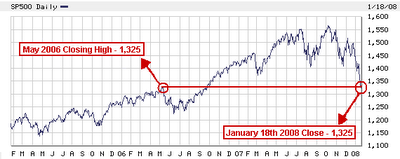
Well, it appears we are now getting a more realistic reaction in the market to the economic challenges we are dealing with. We've dropped 10% in less than 3 weeks, and the selling has been much more widespread. Realistically, we were due for this type of action. That said, the negative sentiment in the market right now is deafening. We won't know how bad things really are until fourth quarter earnings reports and first quarter outlooks are given out over the next 2-3 weeks, but stock prices are starting to price in some really bad stuff. Many contrarian sentiment indicators are signaling we could be starting a bottoming process.

Since nobody can predict when the market will stop going down, I'm not going to waste my time (or yours) hazarding a guess. I will say this, however. Investors should pay close attention to this month's earnings reports and conference calls. Stock prices are now being driven by fear, and I think many of them are not reflecting what is likely to happen as we navigate through 2008. We could certainly fall another 5%-10%, after all things are not good and I'm not trying to say they are, but we should still be getting ready to pounce.

Personally, I am not going to be doing any meaningful buying until I see these earnings reports and listen to quarterly conference calls. But after that, I think it might be time to dip a toe in the water with cash positions. Even if we keep heading lower short term, a year or two from now I think it will pay off in spades.

Earnings Estimates for 2008 Appear Overly Optimistic

Although fourth quarter earnings reports just started to trickle in, consensus estimates call for 2007 S&P 500 profits to be essentially flat with 2006. Given the huge year-over-year declines in the financial sector, the largest piece of the index, this is not very surprising.

What is surprising is that analysts are projecting 2008 earnings to grow by more than 15%. We all know that analysts are rarely spot on with their forecasts, but the possibility of this number being accurate seems even less likely than normal. While the market's P/E using the current forward estimate (less than 14) is not high by any means, bullish investors hoping for a solid market gain this year (at or above historical averages) likely need strong earnings growth to make the case.

Given the economic backdrop right now, a less impressive year in the market (more in line with last year) seems like a more reasonable expectation. As far as the economy goes, 2008 probably will be more of a "sorting out" year than a "snap back" one. As a result, I think the return of double digit earnings growth for the S&P 500 likely won't return until 2009 at the earliest.

JPMorgan Chase Shines In Otherwise Ugly Financial Sector

Of course, a shining performance is all relative when we are talking about the banking sector right now, but still, JPMorgan Chase (JPM) has really navigated this rough environment well so far. I don't own the stock, but certainly wouldn't mind being a shareholder right now. This morning the company reported that 2007 earnings rose 15% to $4.38 per share. Fourth quarter numbers were down sharply, not surprisingly, but overall the company is faring much better than competitors like Citigroup (C).

Not only does JPM have much less CDO and sub-prime mortgage exposure, but their credit card portfolio is holding up very well too. Their credit standards clearly have been more conservative than other players. For the fourth quarter, card delinquencies reached 3.5%, up from 3.1% in the prior year, and net charge-offs were 3.9%, versus 3.5% in 2006. While these figures did rise year-over-year, they remain very low for the industry, where many are reporting figures above 5% in recent months.

JPMorgan's management team, as well as their shareholders for betting on CEO Jamie Dimon, should be congratulated for posting a 15% increase in 2007 earnings per share. There are few banks out there that will be able to claim that feat when earnings season is over later this month. The stock, meanwhile, yields nearly 4% and trades at less than 10 times earnings. The shares will likely continue to outperform their peers going forward.

Full Disclosure: No position in C or JPM at the time of writing

What To Do When Investments Turn Into Great Trades

John from California writes:

"I know you are a long term investor, but given that one of your 2008 Select List picks just went up 30% in a matter of days, I'm stuck as to what to do, sell or hold on? Any thoughts?"

John, thanks for the question. A common answer to this dilemma (feeling compelled to book gains even if your time horizon has not played out yet) is to sell a portion of the position. This gives you the best of both worlds by booking some profits but staying in the stock. Oftentimes I will sell half of a position if I'm really torn about what to do.

However, this works best with large gains (say 100%) because you accomplish both taking a lot off the table and maintaining a sizable position for meaningful further gains. With a 30% gain, however, selling half brings your overall position size down to about one-third less than the level it was less than a week ago, which could very well be too small for your taste.

In that case, I might consider selling 20%-25% rather than 50% in order to keep a full sized position for the long term. After all, the Select List is geared for intermediate to long term investors, even if gains over the first week for one of the picks was unusually high. Hope that helps.

BAC/CFC Baseball Analogy

Sometimes baseball analogies work as well as anything to help explain something. With Bank of America (BAC) buying Countrywide (CFC) for $6.1 billion ($4.1 billion in stock plus the $2 billion in cash they invested last year), one came to mind. I think this is a lot like when a major league pitcher hurts his arm badly and elects to have "Tommy John" surgery. You have to sit out a full year, but the club is banking that an extended period of time off will result in maximum recovery, resulting in the player pitching like this old self when he returns the following year. You sacrifice the near-term in order to maximize long term upside potential.

Bank of America was already the largest mortgage player among the big diversified banks. Adding Countrywide (the largest independent mortgage company) makes them the Goliath in the industry. In the short term, this will hurt them. More losses, more write-downs, more delinquencies until the cycle hits bottom and stabilizes. It won't be pretty. But when the cycle does turn, losses have largely been absorbed, and we (hopefully) get back to a time when you put money down and get a fixed rate mortgage to buy a home, the BAC/CFC combo could be a home run.

To put the purchase price of $6 billion in perspective, Countrywide earned between $2.2 billion and $2.7 billion in profit every year between 2003 and 2006. Obviously the later years were more "bubbly" in nature, but if you look out several years, when the overall mortgage market will be larger in volume terms (despite lower margins most likely as ARMs dissipate), the CFC deal could easily add $2 billion in annual profit to BAC's business after you factor in cost savings from the merger and cross-selling to a new customer base. That puts BAC's cost basis at 3x earnings, even after factoring in the $2 billion convertible preferred investment last year. Clearly that is what Bank of America CEO Ken Lewis is banking on, pun intended.

Full Disclosure: Long shares of Bank of America at the time of writing